Will silicone melt or burn? From kitchenware and medical devices to automotive seals and electrical insulation, silicone rubber is widely used across industries, because of its impressive ability to withstand extreme temperatures. When sourcing materials for kitchenware, industrial gaskets, or medical devices, one question frequently arises: Will silicone melt or burn? The short answer is that genuine silicone does not melt like common plastics, nor does it easily burn.
However, its behavior under extreme heat is nuanced and depends heavily on its chemical structure. For engineers, product designers, and purchasers, understanding exactly how silicone behaves under heat is critical for material selection and product safety.
This article provides a evidence-based answer to two essential questions: Does silicone melt? Does silicone burn? It will help you understand why silicone is the preferred material for high-temperature applications.
The Fundamental Chemistry: Why Silicone Behaves Differently?
To understand why silicone doesn’t melt or burn easily, we must look at its molecular backbone. Unlike most organic plastics, which have a carbon-carbon chain, silicone (polysiloxane) is built on a chain of alternating silicon and oxygen atoms (silicon-oxygen bond).
- Bond Energy: The Si-O bond has a bond dissociation energy of approximately 452 kJ/mol, significantly higher than the C-C bond (about 348 kJ/mol) found in typical plastics. This higher energy requirement makes the silicone backbone inherently more resistant to thermal degradation.
- Inorganic Nature: This silicon-oxygen structure is more akin to glass or quartz than to petroleum-based polymers. Consequently, when heated to extreme temperatures, silicone does not drip or flow like melting plastic. Instead, it undergoes a process of thermal decomposition.

Will Silicone Melt or Burn?
Does Silicone Melt?
Key Factual Takeaways:
- Silicone has no fixed melting point and cannot fully melt into free-flowing liquid. Silicone rubber (both solid silicone-HTV and liquid LSR) is a fully cross-linked thermoset polymer. Unlike thermoplastics (PP, PVC, PET), permanent chemical bonds lock its 3D molecular network after curing. When overheated, silicone chemically decomposes rather than liquefying and dripping like plastic.
- Silicone only ignites under extreme, sustained high heat (~450°C auto-ignition threshold). Standard silicone grades do not burn under regular household, medical sterilization or general industrial operating temperatures. When exposed to open flame, pure silicone exhibits self-extinguishing behavior once the heat source is removed.
Does Silicone Have a Melting Point?
The short answer is no. Silicone does not have a traditional melting point like plastics or metals. Unlike thermoplastics (such as polyethylene or polypropylene) that soften and liquefy when heated, silicone is a thermoset elastomer. Its molecular structure consists of a permanent crosslinked network, formed during the curing process, which cannot be undone by reheating.
The silicone backbone is built from alternating silicon and oxygen atoms (Si-O), forming bonds that are significantly stronger than the carbon-carbon (C-C) bonds found in organic polymers. This inorganic backbone, combined with the crosslinked network structure, means that when silicone is exposed to high temperatures, it does not flow, drip, or deform into a liquid. Instead, it gradually decomposes. The polymer chains break down chemically, causing the material to harden, crack, discolor, or become brittle.
- No Liquid Phase: When heated beyond its operational limits, silicone does not turn into a flowing liquid. It gradually softens and loses its mechanical properties.
- Thermal Degradation: The continuous service temperature for standard solid silicone rubber typically ranges from -55°C to 230°C (-67°F to 446°F). Specialized formulations can withstand intermittent exposure up to 300°C (572°F). Beyond this range, the material begins to degrade chemically rather than physically melt. The polymer backbone breaks down rather than liquefying.
- Ash Formation: If you continue to apply heat, the organic groups (like methyl groups) attached to the silicon backbone will oxidize. The material will eventually decompose, leaving behind a non-conductive silica (SiO₂) ash. This is a key differentiator from plastics, which often burn away completely or leave a carbonaceous char.
To put it precisely: silicone does not melt into a liquid. It will never behave like wax or plastic under heat. At sufficiently high temperatures, it undergoes thermal decomposition, leaving behind a residue—typically silica (silicon dioxide).
Will Silicone Melt in Ovens, Air Fryers or Microwaves?
One of the most searched user questions: Does silicone melt in the oven? Can I Use Silicone Bakeware In The Microwave Or Oven?
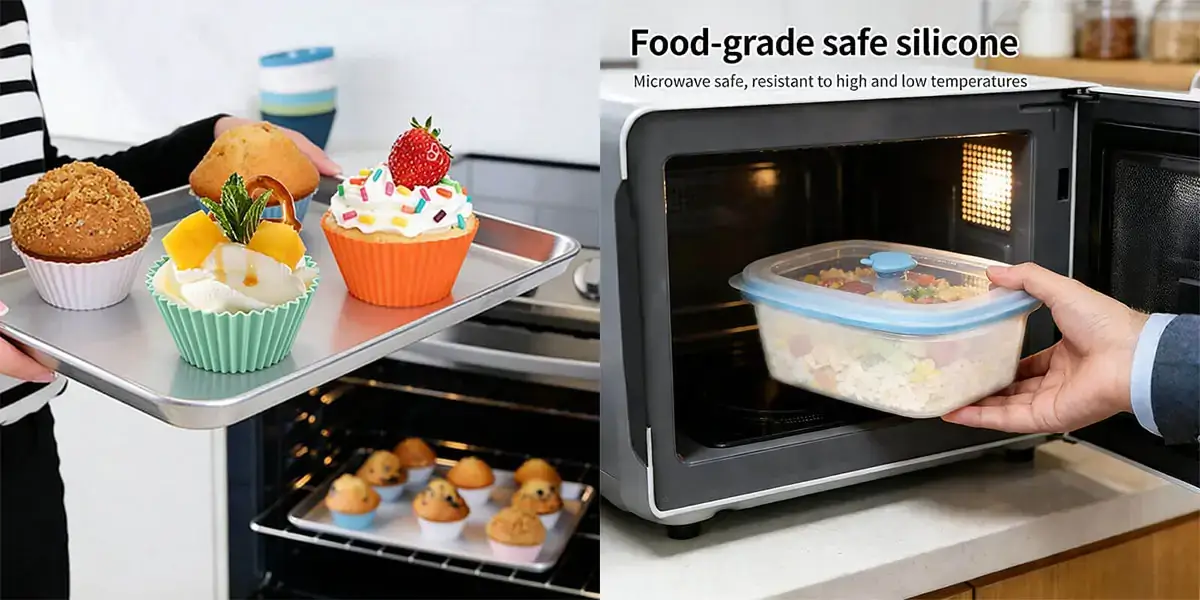
- Household electric/gas ovens max standard setting: 200–260°C. Most daily baking sits between 160–220°C, fully under silicone’s 230°C continuous safe limit.
- Air fryer operating range: 160–200°C; food-grade silicone liners show zero deformation or melting after thousands of test cycles.
- Microwave heating: Pure silicone is non-polar, does not absorb microwave radiation or self-heat; boiling water (100°C) poses no thermal risk whatsoever.
Edge case warning: If silicone food products are left touching uninsulated heating elements exceeding 300°C for extended periods, permanent charring will occur. But no liquid melting will take place. We always advise custom kitchen silicone clients to design products with spacing from direct heating coils for maximum lifespan.
Does Silicone Burn? Understanding Its Flame Behavior
The question of whether silicone burns is more complex. Silicone is not easily flammable under normal conditions, but it can burn when subjected to extreme heat. Understanding the distinction between “ignition” and “combustion” is key here.
Under typical ambient temperatures (below 250°C), silicone is not easy to ignite. It has an ignition temperature of approximately 450°C and a flash point of 750°C. For context, a typical household oven operates at around 180°C to 230°C, well below silicone’s ignition threshold.
When silicone does ignite, its combustion behavior differs markedly from that of organic polymers. Silicone rubber has a limiting oxygen index (LOI) ranging from 26% to 42%. The LOI is a measure of the minimum oxygen concentration required to sustain combustion. Since the oxygen concentration in ambient air is approximately 21%, this means silicone requires a significantly higher oxygen level than what is present in normal air to support sustained combustion. This is why silicone exhibits excellent flame retardancy and is considered self-extinguishing in many scenarios.
A crucial safety advantage of silicone is that during combustion, it does not release halogens (such as chlorine or fluorine) or other highly toxic gases commonly emitted by burning PVC and other conventional plastics. The primary combustion products are carbon dioxide, water vapor, and silica. Only minor amounts of smoke are evolved, and no toxic gases like hydrogen chloride (HCl) or sulfur compounds are released. Some silicones, when exposed to direct flame, can char and form a protective ceramic layer (silica shell), which acts as a fire barrier and prevents further burning.
However, it is important to note that while the main combustion products are non-toxic, any material burned in an oxygen-deficient environment can produce incomplete combustion byproducts that may be irritating or harmful. Additionally, when certain silicones are heated to temperatures exceeding 150°C in the presence of air, trace amounts of formaldehyde vapor may form. Proper ventilation should always be ensured in any fire scenario.
Combustion and Flammability:
Standard silicone rubber is generally not considered highly flammable, but it is not entirely fireproof.
- Ignition Temperature: Silicone typically has an ignition temperature above 400°C (752°F). It will not ignite easily under normal conditions.
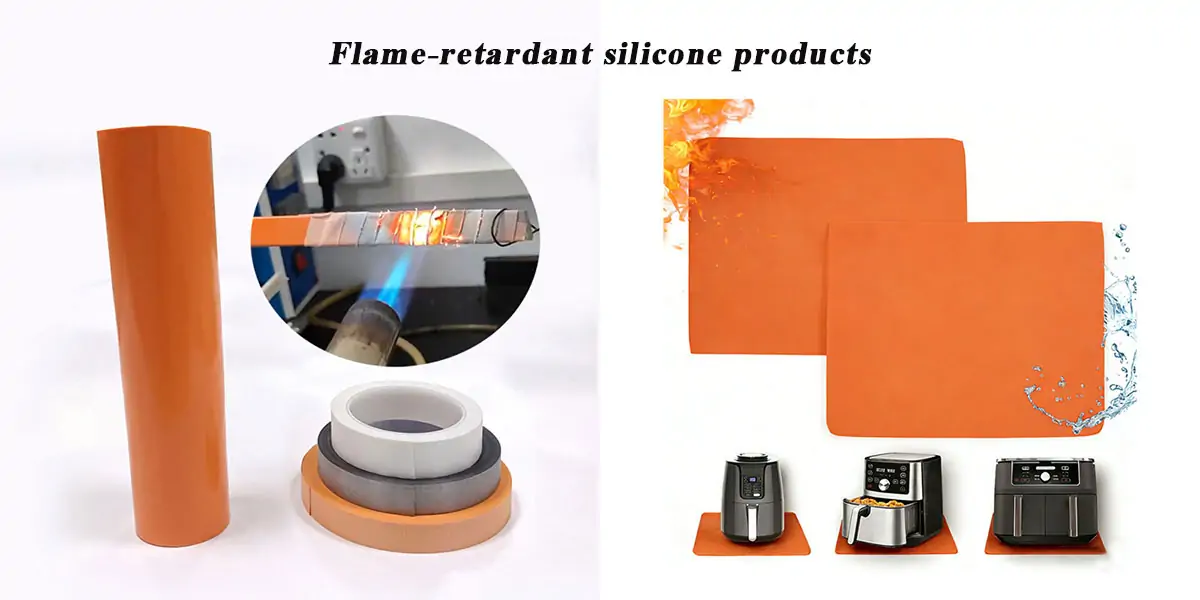
- Flame Retardant Additives: Many commercial silicone products include flame-retardant additives to meet specific safety standards, such as UL 94 V-0. These flame retardant silicone compounds are formulated to self-extinguish once the external flame source is removed.
- Combustion Byproducts: If forced to burn in a sustained external flame, silicone will combust. The primary byproducts are amorphous silica (the white ash), carbon dioxide, and water vapor. It does not produce the flaming, dripping droplets characteristic of burning plastic, which reduces the risk of fire spread and burn injuries.
Ignition & Self-Extinguishing Traits:
- Self-extinguishing core trait: Once external flame is removed, silicone’s slow combustion stops within 2–5 seconds, unlike plastic that sustains open flame independently.
- No molten dripping during burning: Thermoplastics create burning liquid drips that spread fire; silicone remains solid char before breaking into inert silica ash, drastically lowering flame spread risk for electronics and building insulation.
- Low-toxicity combustion byproducts: Silicone smoke contains no dioxins, chlorine or heavy metal fumes released by burning PVC, ABS or polystyrene. This is why silicone is mandated for medical and enclosed electrical device silicone components.
- Custom flame-retardant silicone options: For clients requiring UL94 V-0 rated silicone parts (electrical enclosures, battery insulation, fire door seals).
Siliconexy formulates silicone with non-toxic flame retardant additives to raise ignition temperature above 500°C and cut smoke density during combustion.
What Are Silicone’s Temperature Limits in Practical Use?
For practical purposes (design, manufacturing, and everyday product use) understanding silicone’s operating temperature ranges is more important than theoretical decomposition points.
- Standard silicone rubber can operate continuously at temperatures from -60°C to approximately 230°C (-76°F to 446°F). Within this range, the material retains its elasticity and physical integrity.
- For short-term or intermittent exposure, many silicone compounds can withstand temperatures up to 300°C (572°F). However, at this temperature, the material will degrade in a matter of minutes.
- Specialty high-temperature grades are available. High-temperature vulcanized (HTV) silicone with specific fillers and formulations can achieve higher thermal stability. Some silicone rubbers are capable of operating normally from -100°C to 350°C (-148°F to 662°F), though specific properties such as tensile strength and elongation may be affected at the extremes.
- By comparison, common organic rubbers have significantly lower temperature limits: EPDM maxes out at approximately 150°C, NBR softens above 120°C, and natural rubber degrades above 80°C.
This explains why silicone is frequently the material of choice for applications involving prolonged exposure to elevated temperatures.
Will Silicone Melt or Burn in a Fire?
In an actual fire scenario (where temperatures can exceed 800°C) silicone will burn, not melt. It will not liquefy and drip burning material, which is a critical safety distinction from thermoplastics that can spread fire through molten dripping. Instead, silicone will char, degrade, and eventually reduce to a powdery silica ash. As previously noted, silicone formulations specifically designed for fire safety can form a hard ceramic shell that protects underlying structures.
How Does Silicone Compare to Other Materials?
The table below summarizes key thermal and fire behavior differences:
| Material | Melts or Flows? | Approx. Continuous Max Temp | Ignition Temp | Key Combustion Byproducts |
|---|---|---|---|---|
| Silicone Rubber | No | 230°C | ~450°C | CO₂, H₂O, silica |
| EPDM | No (decomposes) | 150°C | ~350°C | Smoke, carbon oxides |
| NBR (Nitrile) | No (softens) | 120°C | ~300°C | Smoke, carbon oxides |
| Polyethylene (thermoplastic) | Yes (melts) | 80-100°C | ~340°C | Smoke, carbon oxides |
| PVC (thermoplastic) | Yes (melts) | 60-80°C | ~390°C | HCl, toxic fumes |
Why This Matters for Product Selection?
Understanding silicone’s actual thermal behavior is essential for making informed material choices:
- For kitchenware and food-contact applications (baking mats, spatulas, muffin molds), standard food-grade silicone is safe for normal oven use up to approximately 230°C. Silicone bakeware does not melt or release harmful substances within its rated temperature range. However, direct contact with an open flame (like a gas burner) can cause localized scorching and degradation over time.
- For industrial seals and gaskets, silicone’s ability to maintain elasticity across a wide temperature range (-60°C to 230°C) makes it invaluable for applications from refrigeration seals to oven gaskets. Its flame retardancy and low smoke emission are particularly valued in aerospace, rail, and building applications.
- For electrical insulation, silicone’s thermal stability and dielectric properties, combined with its self-extinguishing characteristics, provide reliable performance in cable sheathing and electronic component seals.
- For medical devices, silicone’s biocompatibility and ability to withstand sterilization temperatures without melting or degrading are key advantages.
Conclusion
So, will silicone melt or burn? Silicone does not melt like plastic. It is a thermoset material with a crosslinked molecular structure that prevents liquefaction. When heated beyond its limits, it undergoes thermal decomposition, hardening, cracking, and eventually breaking down into silica.
Silicone can burn, but only at temperatures well above normal operating conditions (ignition occurs around 450°C). It exhibits excellent flame retardancy, tends to self-extinguish, and produces primarily carbon dioxide, water vapor, and silica. Not the toxic, halogenated gases associated with burning many conventional plastics.
For design engineers, procurement professionals, and end-users, the key takeaway is this: silicone’s exceptional thermal stability and unique failure mode (decomposition without melting) make it one of the safest and most reliable elastomers available for high-temperature applications.