Have you ever suffered from shipment detention, Amazon listing removal or customer complaints just because you mixed up FDA and LFGB silicone?
Every month, 68% of global silicone buyers search for “LFGB vs FDA” (source: Google Trends, 2026). That’s thousands of people just like you, trying to figure out which certification they need for their markets. These two standards get tossed around like they’re interchangeable. They’re not.
Picking the wrong one can mean your containers get held up at customs, your European buyer walks away, or worse. Your silicone product fails a random spot check and you’re left holding a container full of stuff you can’t sell. Many B2B buyers blindly buy food silicone but fail regional compliance audits.
We are Siliconexy, a professional bulk custom silicone manufacturer. We’ve served 5000+ global distributors, supermarket chains and Amazon sellers, and we see this compliance mistake every single week.
Today we break down official standard gaps, 3 easy on-site inspection methods, certificate checking skills and how to pick the right standard for your sales market.
FDA vs. LFGB Silicone Certification: What Are LFGB and FDA, Anyway?
What Is FDA-Grade Silicone?
🇺🇸 FDA (U.S. Food and Drug Administration). The FDA is the OG food safety standard for North America. Think of it as the gatekeeper for all food contact products sold in the US, Canada, and Mexico.
Their focus is on post-market monitoring. That means they let products hit the shelves first, then keep an eye on them for safety issues. For silicone, they don’t “approve” it. They just label it “Generally Recognized as Safe” (GRAS). It’s like saying, “We’ve checked this, and it’s probably fine.”
The short version: FDA-grade silicone means the material meets the US Food and Drug Administration’s requirements for repeated food contact. The specific regulation is 21 CFR 177.2600.
- Real objective rule: Allows manufacturer self-certification without mandatory third-party sensory test; only chemical migration extraction tests are required.
- Where it applies: USA market primarily. Also accepted in Australia and many other countries as a baseline.
- Cost reality: FDA is the more affordable route. It’s widely used because it’s the minimum standard for the US market.
- Factory real comment: FDA silicone is cost-effective and meets US basic safety requirements, but it’s not strict enough for European markets.
What it actually tests:
FDA looks at extraction limits. How much stuff leaches out when the silicone touches food. The test uses two main simulants:
- Distilled water: for aqueous foods
- n-Hexane: for fatty foods
What it DOESN’T test:
- Whether your food will taste or smell different
- Whether the color bleeds into food
- Sensory evaluation of any kind
FDA compliance is about the recipe. The raw materials used to make the silicone must be on the FDA’s approved list. The regulation doesn’t “approve” your specific product; it sets rules for what can go into it.
What Is LFGB-Grade Silicone?
🇪🇺 LFGB (Lebensmittel-, Bedarfsgegenstände- und Futtermittelgesetzbuch). LFGB is the strict European food safety rulebook (that’s the full name, but we’ll stick to LFGB). If you’re selling to the EU, this is non-negotiable.
Unlike the FDA, the LFGB focuses on pre-market testing. They make sure products are safe before they ever reach consumers. They have strict limits on how much of certain chemicals can leach into food. 10+ specific ones, to be exact.
The short version: LFGB stands for Lebensmittel-, Bedarfsgegenstände- und Futtermittelgesetzbuch — Germany’s Food, Commodities, and Feed Act. It’s the German standard that effectively serves as the premium benchmark across the EU.
- Real objective rule: Mandatory third-party lab test + mandatory sensory test (odor & taste inspection); covers acid, oil, alcohol multi-food simulant tests.
- Applicable scenarios: EU offline supermarkets, European Amazon stations, baby silicone products, high-end kitchen silicone gadgets. Germany, Austria, Switzerland, and premium EU retail. Many European buyers specifically demand LFGB as extra assurance.
- Cost reality: LFGB silicone costs more. Both to test and to produce. The materials need to be cleaner, the post-curing process longer, the pigments certified separately.
- Objective note: LFGB certified silicone can fully pass FDA tests, but FDA silicone can never meet LFGB requirements.
Fun fact: LFGB is so rigorous, it’s often called the “Gold Standard” for food contact materials in Europe. If a product passes LFGB, you know it’s tough.
Why it’s stricter: LFGB doesn’t just ask “did anything toxic leach out?” It asks “did anything at all change about the food taste, smell and appearance?” That’s a much higher bar.
What it actually tests:
LFGB covers everything FDA does, and then some:
- Migration testing: same idea as FDA, but often with more simulants and harsher conditions
- Sensory testing: odor and taste transfer are mandatory. A panel of 6 testers checks if the silicone makes food smell or taste weird
- Color migration: will it stain your food?
- Volatile Organic Compounds (VOCs): must stay below 0.5%
- Peroxide residues: must be fully decomposed
- Organotin compounds: screened and limited
- Heavy metals: checked for migration
FDA vs. LFGB Silicone Certification: The Key Differences at a Glance
The takeaway: Both are food safe. Both mean the silicone won’t poison anyone. But LFGB means it won’t mess with your food’s taste or smell either.
| Aspect | FDA (21 CFR 177.2600) | LFGB |
|---|---|---|
| Region | USA (and baseline elsewhere) | Germany / EU premium |
| Sensory testing (odor/taste) | ❌ Not required | ✅ Mandatory |
| Color migration testing | ❌ Not required | ✅ Mandatory |
| VOC limits | Less strict | ≤0.5% |
| Migration testing | Water + n-hexane | More simulants, harsher conditions |
| Cure system requirement | Not specified | Platinum-cured preferred |
| Cost | Lower | Higher |
| Industry perception | “Entry level” | “Premium / superior” |
The Real Differences: How They Test Silicone
Testing Methods
The biggest difference between LFGB and FDA is how they test silicone.
- FDA: Uses “overall migration” testing. They measure how much total material leaches into food when the silicone is used. It’s a broad test that covers all possible chemicals.
- LFGB: Requires specific migration testing. They test for 10+ individual chemicals, including heavy metals, phthalates, and volatile organic compounds (VOCs). It’s a much more targeted approach.
Temperature Tolerance
If you’re selling silicone products that get hot (like baking mats or kitchen utensils), temperature tolerance matters.
- FDA: Allows repeated use up to 500°F (260°C). That’s hot enough for most home baking and cooking.
- LFGB: Allows short-term use up to 572°F (300°C) and long-term use up to 482°F (250°C). So it can handle higher temps for shorter periods, which is great for commercial kitchens.
Unique LFGB Requirement
Here’s a fun one: LFGB tests for “taste and odor transfer.” The FDA doesn’t.
Why does this matter? European consumers hate silicone that makes food taste weird. If you’ve ever used a cheap silicone mat that left a funny taste on your cookies, you know what we’re talking about. LFGB-certified silicone is less likely to do that.
The Only 100% Reliable Way: Verify Official Food Grade Silicone Certificates
Here’s a blunt truth: Some suppliers will use upgraded sample materials to pass your DIY tests, but their bulk goods still fail official compliance checks. Certificates are the only trustworthy proof for bulk food silicone compliance.
How to Check Valid FDA Silicone Certificates?
When you receive test documents from suppliers, make sure the report clearly marks 21 CFR 177.2600. There is no mandatory food-contact logo required for FDA compliant silicone products.
How to Check Valid LFGB Silicone Certificates?
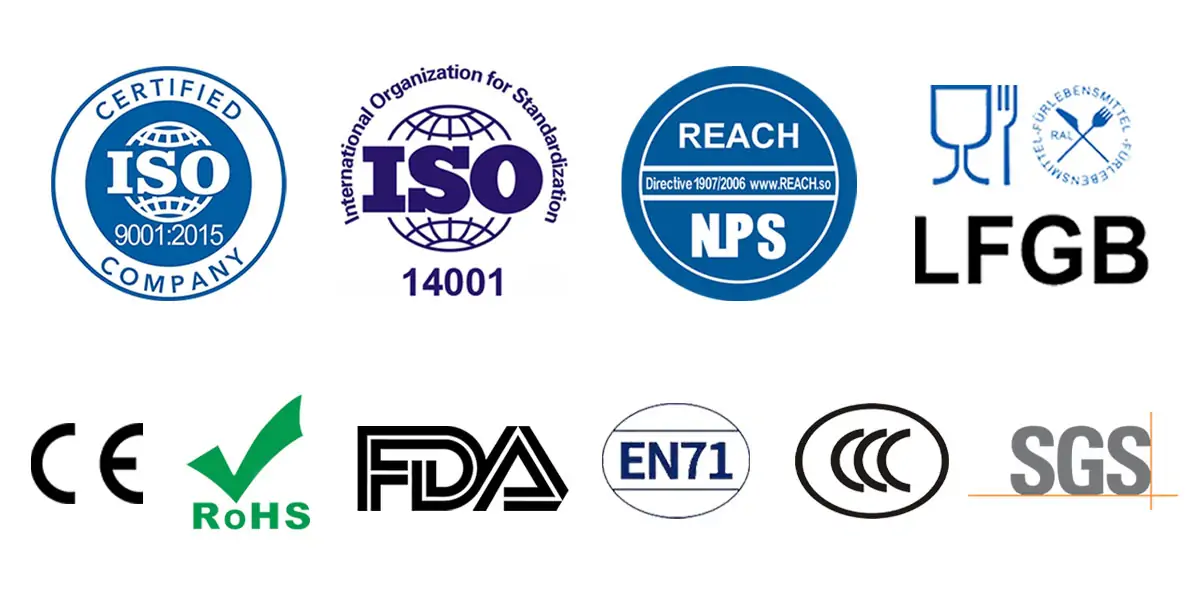
Qualified LFGB reports must list BfR XV standard and complete odor & taste sensory test data. Besides, retail silicone products sold in EU need to print the official EU knife-and-fork food contact logo on packaging.
Common Certificate Scams We Meet In Bulk Orders
We’ve encountered tons of fake or unqualified documents from bad suppliers over the years:
- Generic food-grade certificates with no clear FDA or LFGB standard marked
- Expired test reports reused for new production batches
- Test reports that don’t match your actual silicone product styles
Quick DIY Tests to Tell LFGB and FDA Silicone Apart On-Site
Important honest reminder: These 3 no-cost tests are only for preliminary screening during sample checking or factory visits. They cannot replace official lab test reports. Never approve bulk orders only based on these simple tests.
1. Hot Water Soak & Smell Test (Easiest Check Ever)
This is the most obvious difference you can spot in 15 minutes. Just soak silicone samples in boiling water for 15 minutes, then smell and taste the water lightly.
- LFGB silicone: Zero strange odor, no weird aftertaste transferring to water.
- FDA silicone: Most batches release faint natural rubber smell after heating, which is totally permitted under FDA rules.
2. Stretch White Mark Test (Check Silicone Purity Fast)
Grab the silicone product, stretch it hard and twist it tightly.
- LFGB platinum cured silicone: No white chalky marks appear at all, thanks to pure raw material with no extra cheap fillers.
- Regular FDA peroxide cured silicone: Obvious white stretch marks will show up, as more mineral fillers are added to cut production costs.
3. Long-Time Boiling Aging Test
Boil silicone samples continuously for 30 minutes to simulate daily high-temperature use scenarios.
- LFGB silicone: Smooth surface remains unchanged, no volatile odor released.
- FDA silicone: Mild rubber odor will build up after long high-temperature heating.
Which One Do You Need?
Pick The Right Standard For Your Sales Channels. You don’t need to blindly choose the stricter LFGB standard for all orders. Match certification with your sales channels to save cost and avoid customs clearance risks.
1. Amazon US & North American Supermarkets → Choose FDA Silicone
FDA silicone cuts your raw material cost, meets all local platform and customs rules, and requires no extra third-party audit fees. It’s the most cost-effective choice for North American markets.
2. Amazon EU & European Offline Retail → Must Choose LFGB Silicone
EU customs and Amazon EU have strict food silicone safety audits. FDA-only silicone shipments will get detained directly. LFGB certification also helps you price your silicone products higher for premium European consumers.
3. Cross-Border Sellers Running Both US & EU Stores → Choose Dual-Certified Silicone
No need to prepare two separate inventory batches. Siliconexy provides dual FDA & LFGB certified custom silicone products, covering all North American and European sales scenarios perfectly.
4. Special Reminder For Baby Silicone Products
We highly recommend LFGB certification for all baby contact silicone goods like teething toys and baby feeding accessories, no matter your sales region. It boosts brand trust and avoids all potential safety disputes.
Why This Matters for You?
- Scenario 1: You’re selling to US supermarkets or Amazon US. FDA is your baseline. You don’t need LFGB unless you’re marketing premium. But if your competitor has LFGB and you don’t, that might be a selling point they use against you.
- Scenario 2: You’re selling to Germany, France, or premium EU retailers. LFGB isn’t optional, it’s expected. Many EU buyers won’t even look at FDA-only products.
- Scenario 3: You’re selling baby products anywhere. Babies put everything in their mouths. Odor and taste matter. LFGB is increasingly the default expectation for baby feeding items, teethers, and pacifiers.
- Scenario 4: You’re selling beverage-related products. If your silicone touches water, coffee, or anything where taste is critical, LFGB gives you a real edge.
The customs reality:
Germany wants LFGB. America wants FDA. If you ship FDA silicone to Germany and customs checks it, you’re in trouble. If you ship LFGB silicone to the US, you’re fine, but you paid more than you needed to.
4 Costly Compliance Mistakes Bulk Silicone Buyers Keep Making
- Mistake 1: Assuming FDA silicone automatically passes EU LFGB customs inspection. This causes thousands of dollars in cargo detention fees every month for global importers.
- Mistake 2: Judging silicone quality only via appearance and smell, without verifying official batch test reports.
- Mistake 3: Using expired silicone compliance reports for repeated bulk reorders. Platforms and customs now strictly check report validity dates.
- Mistake 4: Asking factories to cancel secondary curing processes for LFGB silicone to cut costs. This action will directly invalidate full LFGB certification.
Conclusion
FDA and LFGB are both legitimate food-grade standards. Neither is “fake.” But they’re not the same thing.
- FDA: safe for food contact in the US. No taste/smell testing. Lower cost.
- LFGB: safe for food contact in the EU. Taste/smell/color testing included. Higher cost. Higher quality bar.
As a purchasing officer, your responsibility is to understand the market and be clear about the customers’ needs. Do not blindly believe the promises made by suppliers; make sure to request relevant documents.
If you’re sourcing silicone for a premium brand, baby products, or anything where the end-user experience matters (and when doesn’t it?), LFGB is worth the extra investment. Your customers might not know what LFGB stands for, but they’ll notice if their food tastes like rubber.