When selecting silicone products or rubber products for your project, one specification you will encounter repeatedly is Shore hardness. When selecting silicone materials for manufacturing, one of the most critical specifications you’ll encounter is Shore hardness. But what exactly is Shore hardness, does it mean, and why does it matter for your application?
For manufacturers and OEM buyers, Shore hardness is an important specification when developing custom silicone products, because it can influence the flexibility, feel, sealing behavior, deformation, and overall performance of a silicone component.
In silicone manufacturing, Shore A hardness is one of the most commonly referenced hardness scales. If you are sourcing custom silicone products, understanding Shore hardness can help you communicate more accurately with a custom silicone product manufacturer and select the right material for your application.
In this guide, we’ll break down everything you need to know about Shore hardness. From the basic definition and testing methods to how different hardness levels affect silicone product performance.
What Is Shore Hardness?
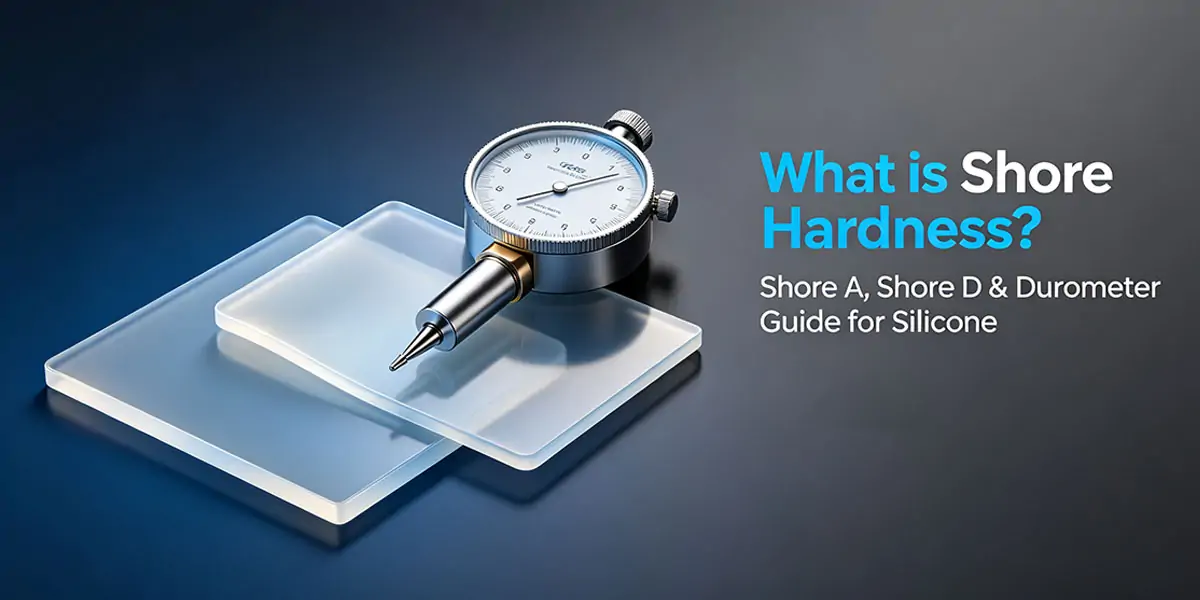
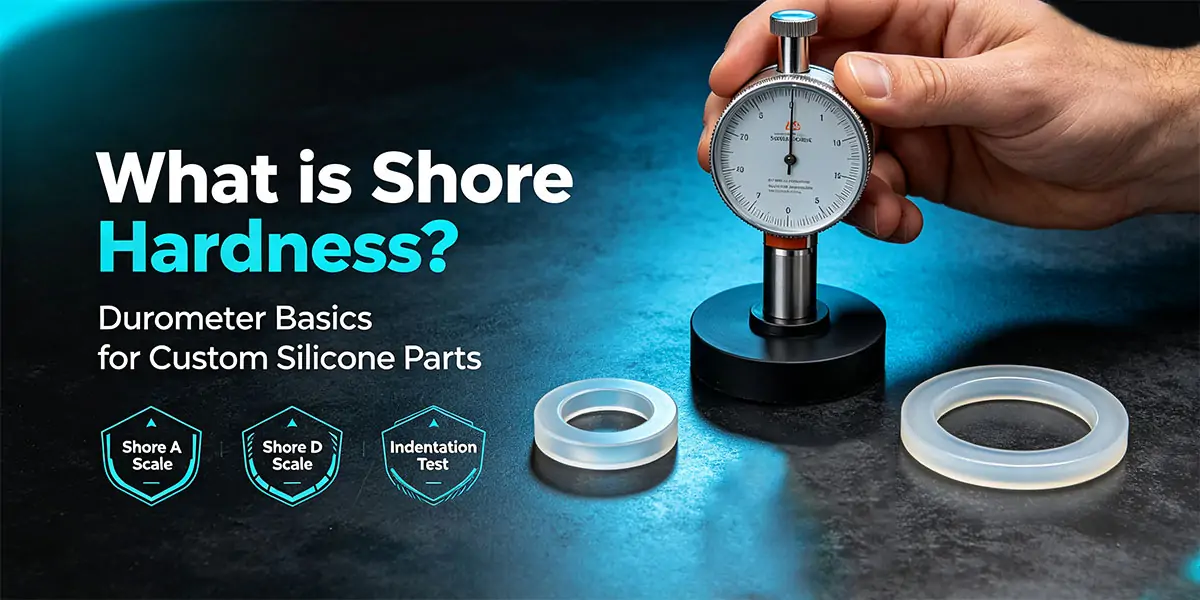
Shore hardness, also widely known as durometer hardness, is a standardized testing method used to measure a material’s resistance to indentation from a calibrated spring-loaded indenter.
Shore hardness is a standardized measure of a material’s resistance to indentation. Essentially, how hard or soft a material feels when pressed. It is most commonly used for polymers, elastomers, and rubbers, including silicone.
The measurement is taken using an instrument called a durometer, which is why Shore hardness is also referred to as durometer hardness. A spring-loaded indenter is pressed into the material under a controlled force, and the depth of penetration is measured on a scale from 0 to 100. A value of 0 indicates a material with no resistance to penetration (extremely soft), while 100 represents a very hard material.
Invented by Albert Ferdinand Shore, this testing system has become the global benchmark for flexible materials, strictly compliant with ASTM D2240 and ISO 48-4 international testing standards.
- ASTM D2240 describes durometer hardness testing for materials including thermoplastic elastomers, vulcanized rubber, elastomeric materials, cellular materials, and some plastics. The standard covers multiple durometer types, including Type A and Type D.
- ISO 48-4:2018 also defines a durometer method for determining the indentation hardness of vulcanized or thermoplastic rubber. It identifies different scales for different hardness ranges, including Shore A, Shore D, Shore AO, and Shore AM.
Why Shore Hardness Matters?
- Material selection: Helps engineers choose the right material for specific applications
- Quality control: Ensures consistency across production batches
- Performance prediction: Indicates how a product will behave under stress, compression, or environmental exposure
- Cost optimization: Avoids over-specifying materials, reducing unnecessary expenses
What Is a Shore Durometer?
A shore durometer is the instrument used to measure Shore hardness. During testing, the instrument applies a defined force through an indenter against the surface of the material. The resulting indentation is converted into a numerical hardness value.
ASTM D2240 emphasizes that the measurement depends on factors including the indenter geometry, applied force, elastic modulus, and viscoelastic behavior of the material. Therefore, readings from different durometer types should not simply be treated as interchangeable.
For this reason, a Shore A durometer and a Shore D durometer are not simply two versions of the same measurement. The correct scale needs to be selected according to the material and its hardness range.
Understanding the Shore Hardness Scales
A key point most buyers overlook is that Shore hardness is not a single-scale system. It includes multiple dedicated scales for different material hardness ranges, among which Shore A and Shore D are the most widely used in silicone and rubber manufacturing. Choosing the correct scale is critical for accurate hardness testing and product specification confirmation. Each scale is designed for different material hardness ranges.
| Scale | Common Materials | Typical Range | Indenter Type |
|---|---|---|---|
| Shore A | Soft elastomers, silicone rubber, flexible polymers | 10–90 | Blunt conical. Truncated cone (blunt) with lighter spring force |
| Shore D | Hard plastics, rigid rubbers, thermoplastic elastomers | 20–90 | Sharp conical. Sharp 30° cone with greater force |
| Shore 00 | Very soft gels, sponge rubber, foam | 10–90 | Rounded |
Shore A is the go-to scale for measuring silicone rubber and other flexible elastomers. Most silicone products fall within the 10 to 90 Shore A range. Shore D, on the other hand, is used for harder materials like rigid plastics and hard rubbers.
There is some overlap between the two scales. For example, a material with a hardness of 100 Shore A is roughly equivalent to 60 Shore D. As a rule of thumb: if a Shore A reading exceeds 90, switch to the Shore D scale; if a Shore D reading falls below 20, switch back to Shore A.
Shore A vs. Shore D: What Is the Difference?
Not all Shore hardness scales are the same. The two hardness scales most commonly discussed in rubber and polymer applications are Shore A and Shore D. Choosing the right one depends on the material you’re testing. For most silicone rubber products, Shore A hardness is the industry standard and is widely specified in technical datasheets.
The main difference lies in the indenter shape and spring force. Shore A uses a blunt indenter suitable for softer materials, while Shore D uses a sharper indenter for harder substances. There is overlap between the two scales around values 80–90, where materials can be measured using either scale for verification.
|
Shore Scale |
Typical Use |
General Material Character |
|
Shore A |
Soft to medium-hard elastomers | Flexible rubber and silicone |
| Shore D | Harder materials |
Hard rubber and harder plastics |
According to ISO 48-4, the Shore A scale is intended for rubber in the normal-hardness range, while the Shore D scale is used for rubber in the high-hardness range. ISO also identifies Shore AO for low-hardness and cellular rubber and Shore AM for thin rubber test pieces.
For many custom silicone rubber products, Shore A is therefore the scale that buyers and manufacturers are most likely to encounter.
Other Auxiliary Shore Scales
Specialized Shore scales include Shore 00 for ultra-soft foam rubber and spongy silicone, Shore B and C for medium-hard rubber materials, which are mostly used in niche industrial testing scenarios and less common in mainstream silicone product customization.
How Is Shore Hardness Measured?
Shore hardness testing follows standardized procedures, most notably ASTM D2240 in North America and ISO 48-4 (which replaced ISO 7619-1) internationally.
Step-by-Step Testing Process:
- Sample preparation: The material sample should have a flat surface, typically at least 6 mm thick.
- Conditioning: Samples are conditioned at standard laboratory temperature (23°C / 73°F) for at least 1 hour.
- Positioning: The durometer is placed vertically onto the specimen, ensuring the presser foot makes full contact with the surface.
- Indentation: The durometer’s indenter is pressed firmly into the material surface.
- Reading: The value is read within a specified time (usually 1–15 seconds after contact).
- Averaging: Multiple readings (typically 5 points, spaced at least 6 mm apart) are averaged for accuracy.
Common Testing Considerations:
- Surface finish affects results: smooth, flat surfaces produce more accurate readings.
- Sample thickness matters: thin samples may yield lower hardness values.
- Temperature variations can impact readings: testing should occur in controlled environments.
Does Higher Shore Hardness Mean Better Silicone?
No. A higher Shore hardness does not automatically mean that one silicone material is better than another. Hardness should be selected according to the requirements of the finished product.
For example:
- A soft silicone component may be preferable when flexibility and easy deformation are important.
- A medium-hard silicone may provide a balance between flexibility and structural support.
- A harder silicone may be appropriate when greater resistance to deformation or a firmer feel is required.
ASTM specifically notes that durometer hardness is an empirical measurement and that there is no simple relationship between a durometer hardness value and a single fundamental material property.
Why Is Shore Hardness Important for Custom Silicone Products?
Shore hardness is not just a number, it directly affects how a silicone product performs in real-world applications. Here’s why it matters:
1. Sealing Performance
For gaskets, O-rings, and seals, hardness determines how well the material conforms to surfaces. Softer silicones (20–40 Shore A) seal better on rough or uneven surfaces, while harder silicones (60–80 Shore A) offer better resistance to extrusion and abrasion. A 70 Shore A durometer is often considered the baseline for many O-ring applications.
2. Flexibility and Durability
Softer materials stretch more easily and are ideal for applications requiring flexibility, such as shoe inserts, medical pads, and consumer goods. Harder materials provide greater structural integrity and wear resistance, making them suitable for automotive components, industrial seals, and high-temperature applications.
3. Manufacturing Consistency
Shore hardness testing is a critical quality control tool. It helps manufacturers detect batch-to-batch variations in compound formulation, filler loading, or cure state. Consistent hardness ensures that every product meets specifications and performs as expected.
4. Material Selection
When designing a new product, understanding Shore hardness helps engineers select the right silicone grade for the job. Whether you need a soft, low-durometer silicone for a comfortable grip or a high-durometer silicone for a durable seal, the Shore hardness value guides the decision.
5. Tactile Feel
For consumer products, the hardness of silicone can significantly influence how the product feels when touched or squeezed.
This is particularly relevant for:
- Silicone grips
- Silicone handles
- Consumer electronics accessories
- Baby products
- Kitchen products
- Personal-care accessories
6. Dimensional Behavior
The hardness of the silicone compound can also influence how a component behaves under mechanical loading. However, hardness should not be used as a substitute for other important properties such as tensile strength, tear strength or compression set.
Shore Hardness Is Not the Same as Tensile Strength
This is an important distinction for buyers of custom silicone products.
- Shore hardness tells you about indentation resistance.
- Tensile strength describes the force required to break a material when it is stretched.
- Elongation at break describes how much the material can stretch before breaking.
- Tear strength measures resistance to tearing.
These properties are related to material formulation but they are not interchangeable.
ASTM D2240 specifically states that there is no simple relationship between durometer hardness and a fundamental property of the material. Therefore, a silicone product specification should not simply say: “Use 60 Shore A silicone.”
Why Can Two Shore Hardness Measurements Be Different?
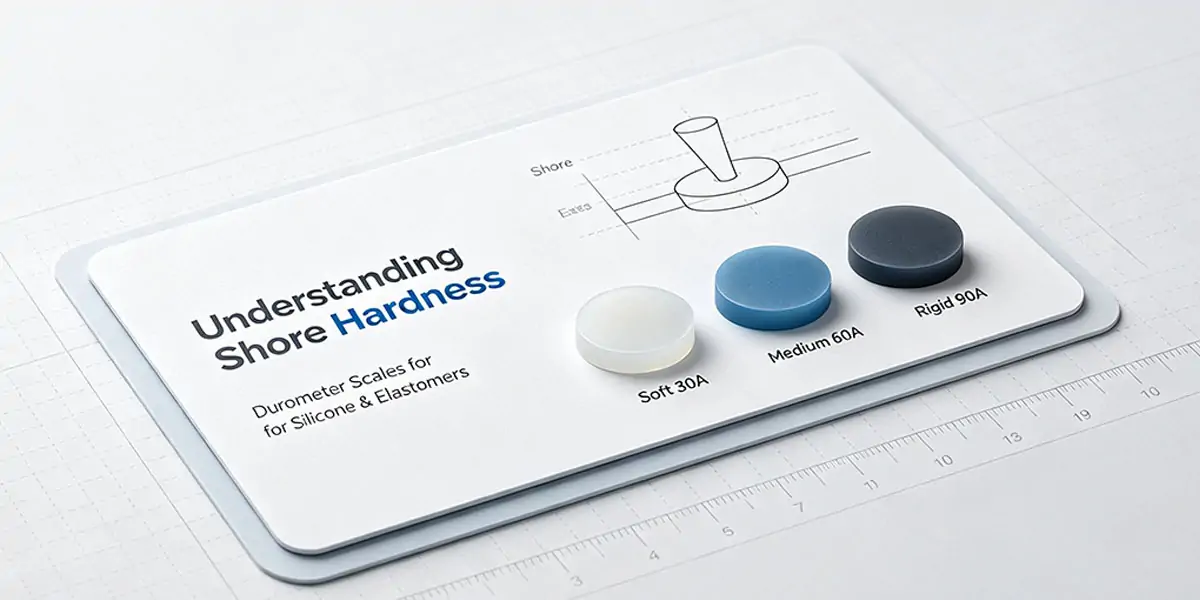
A common mistake in silicone product sourcing is assuming that every hardness measurement will produce exactly the same result. In practice, the measured value can be affected by the test method, durometer type, specimen characteristics and testing conditions.
ASTM D2240 specifically explains that the measurement is influenced by the indenter geometry and applied force, and that results obtained with different durometer types do not have a simple direct relationship.
How Should You Specify Silicone Hardness to a Manufacturer?
If you are developing a custom silicone product, a clearer specification might look like:
- Silicone Rubber — 50 ± X Shore A — ASTM D2240
The exact tolerance should be agreed between the customer, engineering team and manufacturer based on the material, product design and quality requirements.
For a production project, it is also useful to establish whether hardness will be verified using:
- A standardized test specimen
- A molded test piece
- The finished product
- A production batch sample
The testing method matters because ASTM D2240 is intended to standardize the indentation measurement rather than provide a universal prediction of how a finished component will perform.
There is no single “best” Shore hardness for every silicone product. Instead, the hardness should be selected based on the function of the component.
The appropriate hardness depends on:
- Compression requirements
- Sealing pressure
- Installation method
- Temperature
- Media exposure
- Silicone Tubing
Hardness can affect flexibility, handling and resistance to deformation.
How to Choose the Right Shore Hardness for Your Project?
Selecting the correct hardness for silicone products depends on several factors.
Key Selection Criteria
- Application requirements. Will the product need to compress, seal, or provide structural support?
- Environmental conditions. Consider temperature, chemical exposure, and UV light
- Mechanical stress. Higher durometer values resist deformation better under load
- User comfort. Softer materials (lower Shore A) are preferable for wearable or skin-contact products
- Regulatory standards. Food-grade and medical applications require specific certifications
Practical Tips
- For gaskets and seals, Shore A 40–60 typically offers a good balance between flexibility and sealing force
- For kitchenware (such as spatulas and baking molds), Shore A 50–70 provides durability with flexibility
- For medical-grade applications, Shore A 20–40 is often preferred for patient comfort
Shore Hardness vs. Silicone Hardness: Are They the Same?
In everyday silicone manufacturing discussions, “silicone hardness” and “Shore A hardness” are often used together. However, they are not technically identical terms.
Silicone hardness is a general description of how hard or soft a silicone material is. Shore A hardness is a specific numerical measurement obtained using a defined durometer scale.
For example: “Silicone hardness: 50 Shore A” is much more useful as a technical specification than simply “Silicone hardness: medium”.
For an OEM project, always confirm the hardness scale and applicable testing method.
Conclusion
Shore hardness is a standardized measurement of indentation resistance, commonly used to describe the hardness of rubber, silicone and other elastomeric materials. Shore hardness is one of the most important specifications for any silicone product. It affects sealing performance, durability, manufacturability, and end-user experience.
By understanding the Shewhart hardness grades and the differences between Shewhart A and Shewhart D, it can help you make more informed decisions when choosing materials for your next project.
When developing a custom silicone component, the right material selection should consider hardness, tensile strength, elongation, tear strength, compression set, temperature resistance, chemical resistance, product geometry and intended application.
At Siliconexy, material selection should begin with the function and requirements of the final product, not simply with a hardness number. For OEM/ODM silicone projects, providing the product drawing, application requirements, target hardness and expected operating conditions can help the manufacturer determine the appropriate silicone material and manufacturing process.
Need a custom silicone product with a specific Shore A hardness? Contact Siliconexy to discuss your product requirements, material selection and OEM/ODM manufacturing solution.