Published by Siliconexy (Xinyin) | Custom Silicone Products Manufacturing Solutions
If you have ever reviewed a silicone tubing datasheet or submitted a custom OEM inquiry, you have encountered the term Shore A hardness which typically expressed as a number between 10 and 80, followed by the letter “A.” Engineers and buyers often specify silicone hardness using the Shore A scale.
Selecting the correct silicone hardness is one of the most critical steps in custom silicone product manufacturing that directly impacting product durability, flexibility, sealing performance, and application compatibility.
A silicone product that is too soft may deform too easily, while one that is too hard may lose the flexibility, cushioning, sealing, or tactile feel required for the application.
For designers, OEM buyers, and manufacturing engineers, understanding silicone Shore A hardness is essential to avoid material failure, excessive wear, and application mismatch in silicone gaskets, seals, tubing, and custom molded silicone parts.
But how do you choose the right Shore A hardness for a custom silicone product? The answer isn’t simply a matter of choosing a higher or lower value; it depends more on the product’s functionality, geometry, compression requirements, flexibility, operating environment, and other material properties.
What Is Shore A Hardness for Silicone Rubber?
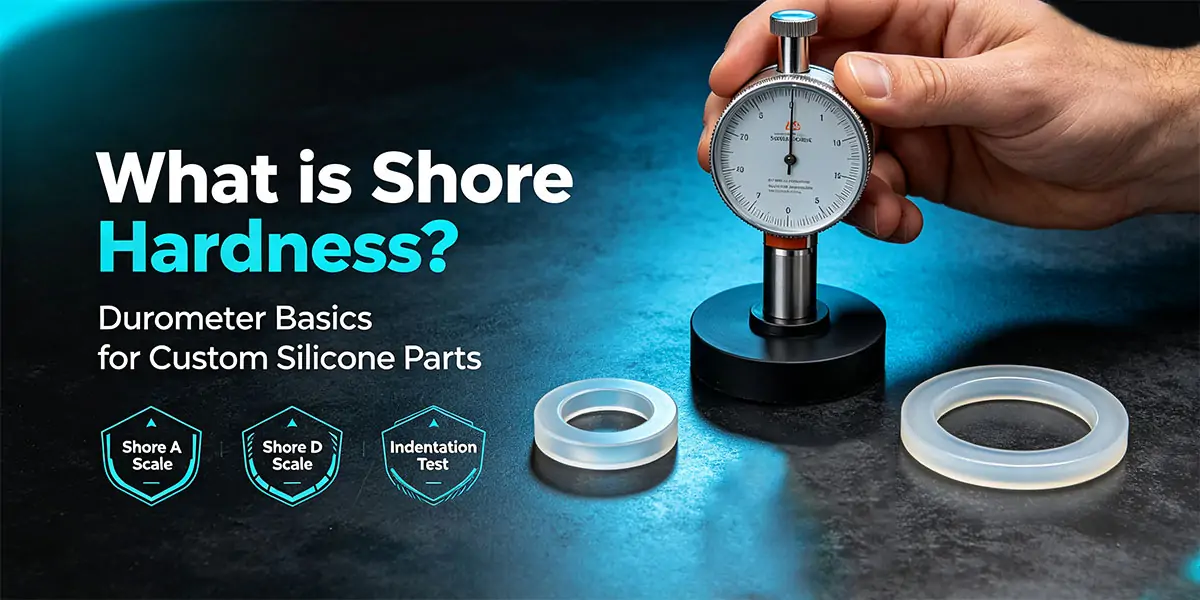
Shore A durometer is the universal industry scale for measuring the hardness and flexibility of soft elastomers, including all types of food-grade, medical-grade, and industrial-grade silicone rubber.
Simply put: Shore A hardness is a commonly used method for measuring the indentation hardness of rubber and elastomeric materials.
This hardness tester measures a material’s resistance to indentation using a professional hardness tester in accordance with the official ASTM D2240 test method. The lower the Shore A value, the softer and more stretchable the silicone is; the higher the value, the harder and more rigid the silicone is.
However, Shore A hardness should not be treated as a direct measurement of tensile strength, tear strength, or overall durability. ASTM notes that durometer hardness is an empirical measurement and does not have a simple one-to-one relationship with a fundamental material property.
Unlike Shore 00 (for ultra-soft silicone gels) and Shore D (for rigid hard plastics), the Shore A silicone hardness range (10A–90A) covers nearly all commercial and industrial silicone products on the market. Most custom silicone components for sealing, cushioning, and daily use fall within the 10A to 80A Shore A spectrum, making it the most reliable reference for bulk silicone procurement and custom molding projects.
Common Silicone Shore A Hardness Ranges
Different Shore A hardness grades deliver distinct mechanical properties, suitable for diverse usage scenarios. Below are the most widely used Shore A silicone hardness specifications and their optimal applications, summarized from real manufacturing and engineering practices.
1. Ultra-Soft Silicone (10A–30A)
10A to 30A soft silicone features excellent elasticity, ultra-high flexibility, and outstanding vibration damping performance. This low durometer silicone is resistant to cracking during repeated bending and stretching, ideal for soft-touch silicone grips, flexible silicone cushions, medical silicone pads, and ultra-soft sealing gaskets.
It is also widely used in baby product silicone accessories and wearable device silicone parts, where skin-friendliness and soft texture are top priorities. The only limitation is low structural strength, so it is not recommended for high-pressure load-bearing scenarios.
2. General-Purpose Medium Soft Silicone (30A–50A)
30A–50A Shore A silicone is the most versatile and popular hardness grade in the silicone manufacturing industry. It balances perfect flexibility, tear resistance, and structural stability, with excellent compression set resistance for long-term use.
This grade is the standard choice for silicone seals, routine extrusion silicone tubing, kitchen silicone utensils, and daily-use silicone accessories. Most standard OEM silicone projects adopt 40A or 50A silicone as the baseline material for its all-round performance and cost-effectiveness.
3. Medium-Firm Silicone (50A–70A)
50A to 70A firm silicone boasts enhanced rigidity, pressure resistance, and deformation resistance, capable of withstanding continuous clamping loads and mechanical friction. It is the preferred material for high-pressure silicone gaskets, industrial equipment sealing parts, waterproof silicone keypads, and mechanical shock-absorbing silicone components.
This hardness range avoids excessive deformation under heavy loads, ensuring stable sealing and structural performance in mechanical and industrial automation equipment.
4. High-Firm Hard Silicone (70A–90A)
70A–90A high-hardness silicone features strong structural stability and abrasion resistance, with minimal flexibility. It is specially designed for rigid silicone structural parts, industrial wear-resistant silicone components, and high-load mechanical accessories.
Note that silicone exceeding 90A will transition to the Shore D scale, which is rarely used for standard silicone products and usually reserved for semi-rigid plastic-like elastomers.
Silicone Hardness Chart: What Do Different Shore A Values Feel Like?
here is no universal rule that assigns one Shore A hardness to every type of product. The following guide can be used as a starting point for custom silicone product development.
| Silicone Hardness | General Feel | Typical Considerations |
|---|---|---|
| 10–20 Shore A | Very soft | Soft-touch, cushioning, flexible components |
| 20–30 Shore A | Soft | Flexible parts, soft grips, certain seals |
| 30–40 Shore A | Soft to medium | Flexible molded products and sealing applications |
| 40–50 Shore A | Medium | General-purpose molded silicone products |
| 50–60 Shore A | Medium to firm | Structural flexibility, grips, durable components |
| 60–70 Shore A | Firm | Higher resistance to deformation |
| 70–80 Shore A | Hard | Rigid-feeling silicone components and specific industrial applications |
These ranges are only a practical reference. Actual material availability depends on the silicone formulation and supplier.
Therefore, the correct question is not simply “What Shore A hardness should I choose?” A better question is: “What Shore A hardness provides the required performance for my specific product design?”
How to Choose Silicone Hardness for Your Product?
1. Start With the Product’s Function
The first step is to determine what the silicone component actually needs to do.
A soft silicone compound may be appropriate for a flexible or cushioning component, while a firmer compound may be more suitable when dimensional stability and resistance to deformation are important.
This is why silicone hardness selection should begin with application requirements rather than a predetermined Shore A number.
2. Consider Flexibility
If the product needs to bend, fold, stretch, or conform to another surface, a lower hardness may be appropriate.
However, reducing hardness does not automatically improve every performance characteristic.
A very soft silicone may provide a softer feel but may also behave differently under compression, tearing, stretching, or dimensional loading.
The final formulation should therefore be evaluated against the complete product specification.
3. Consider Compression and Sealing
For silicone seals and gaskets, hardness is particularly important because the material needs to deform sufficiently to create and maintain contact with the sealing surfaces.
For sealing applications, simply selecting a harder silicone is not necessarily better.
The manufacturer should evaluate hardness together with compression set, tensile strength, tear strength, geometry, and operating conditions.
4. Consider Product Geometry
The same silicone hardness can behave differently depending on the thickness and geometry of the finished part.
A thin silicone wall may feel flexible even when the material has a relatively high Shore A hardness.
A thick molded component made from the same material can feel substantially firmer.
Therefore, hardness selection should be evaluated together with: wall thickness, part dimensions, ribs, corners, holes, undercuts, flexible sections and contact areas.
For a custom silicone product, the final mechanical behavior comes from the combination of material properties and product design.
Key Factors to Choose the Right Silicone Durometer
Beyond basic application scenarios, professional silicone hardness selection requires combining actual working conditions to avoid material mismatch.
- Working pressure and load: Low-pressure sealing and cushioning scenarios choose 30A–50A soft silicone; high-pressure, heavy-load mechanical applications require 60A–80A firm silicone to prevent compression deformation.
- Bending and movement frequency: Parts with frequent bending, stretching, and vibration need low Shore A silicone (10A–40A) to maintain elasticity and extend service life.
- Surface matching requirements: Hard mating surfaces (metal, hard plastic) pair better with medium-soft silicone (40A–50A) to achieve tight, leak-proof sealing; soft contact scenarios adapt to lower durometer silicone.

Choosing Silicone Hardness With an OEM Manufacturer
For custom silicone projects, selecting the appropriate hardness is an engineering decision, not merely a matter of procurement specifications.
At Siliconexy (Xinyin), we work with customers to evaluate silicone material requirements according to the product’s design, application, manufacturing process, and production requirements.
Our manufacturing capabilities include:
- Silicone compression molding
- LSR injection molding
- Silicone extrusion
- Mold manufacturing
- Mass production
- Trimming and finishing
- Quality inspection
- Packing and delivery
For LSR applications, commercially available materials can cover a broad range of Shore A hardness values. LSR grades from approximately 30 to 80 Shore A, demonstrating that material selection can be adjusted according to the required combination of flexibility and mechanical performance.
Our engineering team can review product drawings, samples, application requirements, and target specifications to help determine whether the requested silicone hardness is suitable for the finished product.
Shore A Hardness Range Chart for Silicone Applications
The following table maps Shore A hardness values to material feel, typical applications, and key performance trade-offs. This serves as your silicone durometer chart for rapid reference:
| Shore A Range | Material Feel | Common Applications | Key Considerations |
|---|---|---|---|
| 10A–20A | Very soft / Gel-like | Orthopedic cushioning, soft-touch overmolding, baby teething toys | Excellent comfort and conformability; poor tear resistance; difficult to demold |
| 30A–40A | Soft / Flexible | Medical tubing, soft O-rings, wearable device seals | Good flexibility and sealing at low pressure; may kink in thin walls |
| 50A–60A | Medium / Balanced | General-purpose gaskets, keypads, baby care products, peristaltic pump tubing | Best balance of flexibility, durability, and dimensional stability |
| 70A–80A | Hard / Rigid | Automotive connectors, durable gaskets, industrial rollers, high-pressure seals | Excellent compression set resistance and extrusion resistance; reduced flexibility |
| 80A–90A | Very hard | Precision industrial parts, rigid seals, wear components | Maximum durability and pressure resistance; minimal flexibility |

Common Specification Mistakes to Avoid
- Specifying hardness without specifying the test standard. Always reference ASTM D2240 and state whether the reading is instantaneous or at 15 seconds. These can differ by 2–5 Shore A points.
- Confusing compound hardness with part hardness. A thin-walled tube’s flexibility depends on both the compound’s Shore A value and the wall thickness. Never specify Shore A alone for thin-wall components.
- Ignoring hardness drift after sterilization. Medical-grade silicone can experience slight hardness changes after gamma or autoclave sterilization. Confirm the target Shore hardness range and expected batch variation with your supplier.
- Using Shore A for very hard materials. Readings above 90 Shore A should be made on a Type D durometer. Readings below 10 Shore A may be inexact and should not be reported for some materials.
- Neglecting tolerance bands. Order to a Shore A target with a tolerance band, typically ±5 Shore A. Tighter tolerances require tighter process control and may increase cost.
Is Softer Silicone Always Better?
No. Soft silicone is not automatically better simply because it feels more flexible. A lower Shore A hardness may be desirable when softness, flexibility, or cushioning is important.
However, the product may also require adequate:
- Tear resistance
- Tensile strength
- Compression performance
- Dimensional stability
- Abrasion resistance
- Long-term durability
Therefore, a professional custom silicone manufacturer should look at the complete material specification rather than recommending a hardness number in isolation.
Is silicone with higher hardness always more durable?
Not necessarily. A higher Shore A value typically indicates higher indentation hardness, but this does not mean the material will automatically perform better in all applications.
ASTM D2240 explicitly states that indentation hardness depends on various factors, including the material’s modulus of elasticity and viscoelastic behavior, as well as the geometry of the indenter and the applied force.
For example, products that require repeated bending may perform better with a suitably soft or medium-hardness silicone than with a material that is too hard.
Similarly, sealing components may require careful selection of the appropriate hardness to achieve the desired compressibility and sealing performance.
Therefore, hardness should be optimized rather than simply maximized.
Conclusion
Choose silicone products based on their performance, rather than focusing solely on hardness ratings. Choosing the right silicone hardness is about finding the best balance between softness, flexibility, strength, sealing performance, durability, and manufacturing requirements.
A lower Shore A value may provide a softer and more flexible feel, while a higher value may provide greater firmness and resistance to indentation. But neither is automatically better.
For a successful custom silicone product, evaluate Shore A hardness together with:
- Product function
- Product geometry
- Wall thickness
- Tensile strength
- Tear strength
- Temperature
- Manufacturing process
- Required certifications
The goal is not to choose the hardest or softest silicone. The goal is to choose the silicone hardness that delivers the required performance for the finished product.
If you are developing a custom silicone product and are unsure whether 30, 40, 50, 60, or 70 Shore A is appropriate, send Siliconexy your product drawing, sample, application details, or target specifications. Our OEM/ODM team can help evaluate the material and manufacturing requirements before tooling and mass production.