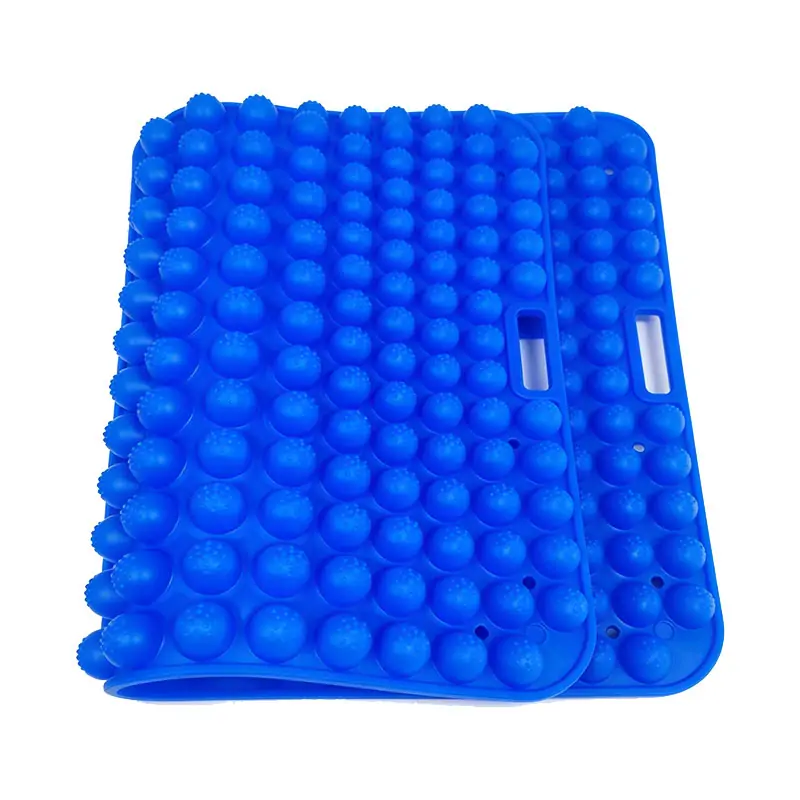
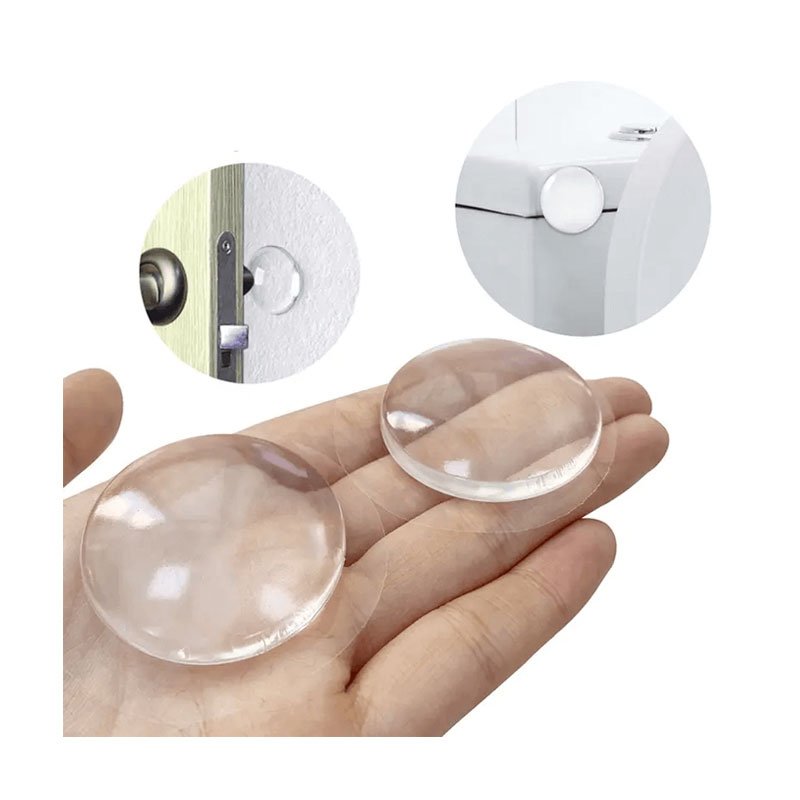
When manufacturing custom silicone products, molding is only one part of the production process. After the silicone product is removed from the mold, it may not yet meet the standards for final inspection or shipment. A thin layer of excess silicone may remain around the parting line, gate, or other molded part areas.
This excess material is commonly referred to as silicone flash.
Even with well‑calibrated silicone compression molding or liquid silicone rubber (LSR) injection molding, thin excess silicone material known as flash often forms along mold parting lines, ejector pin openings and vent locations. Flash is a thin cured silicone fin created when pressurized silicone leaks through micro‑gaps between mold halves during vulcanization.
If left unprocessed, flash ruins surface aesthetics, compromises part tolerances, impairs assembly fit and fails cosmetic quality checks for wholesale silicone products, silicone fidget toys, silicone seals and custom silicone consumer goods.
That is why silicone flash removal and trimming are important post-molding processes in professional silicone manufacturing.
Silicone flash removal and silicone trimming, also widely called silicone deflashing, is the essential secondary post‑molding operation to eliminate mold flash, burrs and parting‑line residues before final quality inspection and packaging. The appropriate method depends on the product design, material, mold structure, required tolerances, and production volume.
For B2B buyers, brand owners and product developers, understanding available trimming techniques helps you set realistic part specifications, control production costs and select the right finishing for your custom silicone OEM/ODM orders.
This article breaks down common silicone trimming processes, their pros‑and‑cons, real‑world use‑cases and key selection criteria for your silicone manufacturing project.
What Is Flash in Silicone Molding?
Flash is excess material that escapes from the mold cavity during the molding process. It typically appears along the parting line, the area where the mold core and mold cavity meet. Flash can also form around ejector pins, through vents, or at gate locations.
During molding, silicone is compressed or injected into the mold cavity. If a small amount of material escapes through the interface between mold surfaces, it can cure into a thin excess edge.
Flash is particularly common around:
- Mold parting lines
- Venting areas
- Complex geometries
- Thin product edges
- Holes and openings
- Inserts
- Small cavities
- Areas where mold surfaces meet
While flash may seem like a minor cosmetic issue, it can have serious consequences. On sealing components like silicone gaskets and O-rings, flash can interfere with proper seating and sealing. In medical devices and aerospace assemblies, even thin flash can compromise part function or assembly. And for any product, visible flash signifies poor quality, an impression that no manufacturer wants to leave.
The amount and location of flash depend on factors such as:
- Product design
- Mold design
- Mold condition
- Material characteristics
- Molding parameters
- Required product tolerances
Therefore, preventing flash starts with proper mold design and manufacturing, not just post-production finishing.
Why Does Silicone Flash Occur?
Silicone flash can occur when material enters small clearances between mold surfaces during the molding process. Silicone flash does not always signal defective tooling, though excessive flash points to process drift or mold wear. Several factors may contribute to flash formation.
Major root causes include:
- Insufficient mold clamping tonnage during compression or LSR injection molding
- Minor gaps, wear or misalignment on mold parting surfaces
- Too‑high injection pressure forcing low‑viscosity silicone to seep out of mold cavities
- Aging molds with degraded sealing edges
- Complex part geometry with multiple split lines and deep undercuts
- Improper venting that allows material to escape
- Material Viscosity: Low-viscosity silicones, often used for intricate parts, are more prone to seeping into mold gaps compared to high-viscosity alternatives
Mold optimization can minimize flash, yet micro‑flash frequently persists for intricate silicone components, making silicone trimming an unavoidable post‑processing step for mass production.
Why Flash Removal Matters?
The silicone deflashing process is not just about aesthetics. For B2B buyers, trimming is particularly important when the silicone product has strict appearance or dimensional requirements. Here’s why it matters:
- Appearance: Excess flash can make a finished silicone product look unfinished or inconsistent.
- Dimensional Accuracy: Uncontrolled excess material around edges may affect the final dimensions of certain components.
- Assembly: For silicone parts designed to fit with other components, excessive flash around interfaces or openings may interfere with assembly.
- User Experience: For consumer products, sharp or uneven edges can negatively affect the perceived quality of the product.
- Quality Consistency: A controlled trimming and inspection process helps manufacturers maintain more consistent results across production batches.
- Long-Term Durability: Rough, untrimmed edges can create stress points that lead to premature tearing or degradation. Proper trimming ensures parts withstand repeated use in harsh environments.
| Reason | Impact |
|---|---|
| Functionality | Flash on sealing surfaces prevents proper compression and sealing |
| Assembly | Flash can block fitment or interfere with mating components |
| Quality perception | Visible flash signals poor workmanship to customers |
| Regulatory compliance | Medical and food-grade parts must meet strict surface finish requirements |
| Consistency | Parts with uncontrolled flash have unpredictable performance |
How Is Silicone Flash Removed?
Main Silicone Flash Removal and Trimming Methods. There is no single trimming method suitable for every silicone product.
There are several methods for removing flash from silicone molded parts, ranging from manual techniques to fully automated processes. The right choice depends on part complexity, production volume, tolerance requirements, and budget. The appropriate silicone flash removal method depends on the product structure, material, production volume, and quality requirements.
A professional custom silicone products manufacturer selects the appropriate method according to product geometry, material characteristics, tolerances, and production volume.
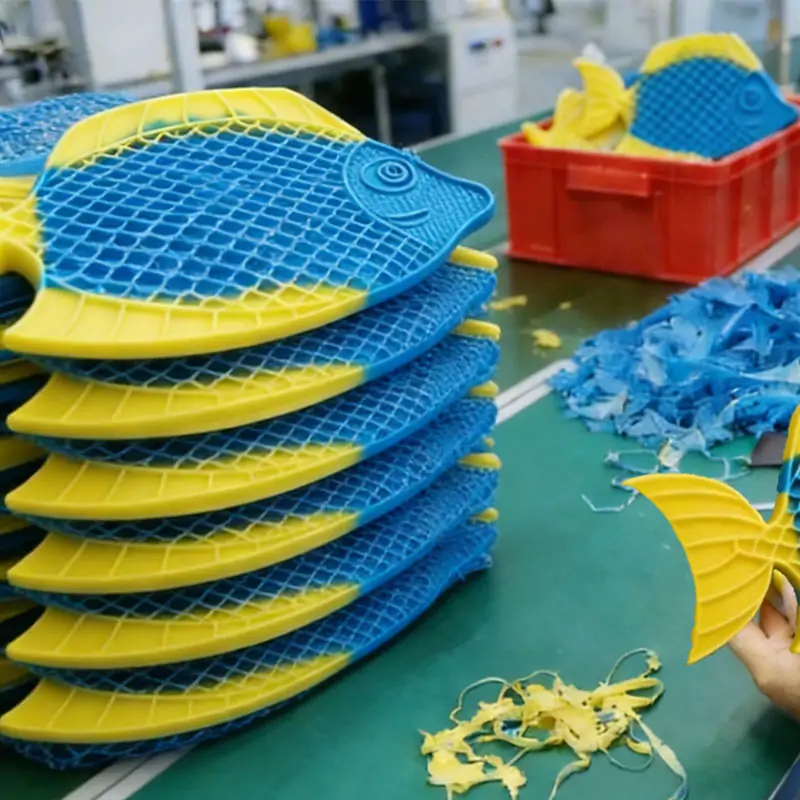
1. Manual Silicone Trimming (Hand Trimming)
Manual trimming is one of the most flexible methods for removing silicone flash. Operators use precision cutting tools, scissors, blades, or other suitable tools to carefully remove excess material from the molded part.
Manual trimming is commonly used for custom silicone products, prototypes, and products with relatively accessible flash areas.
Advantages:
- Low upfront equipment investment;
- Technicians can access irregular contours, undercuts and deep cavities that automated machines struggle to reach;
- Suitable for prototypes and low-volume production;
- Flexible for one‑off custom silicone molding projects.
Drawbacks:
- Labor‑intensive, slow cycle times for bulk production;
- Trimming consistency heavily relies on operator skill;
- Accidental nicks, cuts or incomplete flash residues may appear;
- Higher unit labor cost for large‑volume orders.
Manual trimming is best suited for low-volume production, prototypes, or parts with geometries that are difficult to automate.
When is manual trimming suitable?
Manual trimming can be useful for:
- Prototypes
- Small production runs
- Large silicone components
- Complex geometries
- Delicate parts
- Products requiring selective finishing
For this reason, manual trimming is not necessarily the best solution for every high-volume production program.
Siliconexy applies manual trimming for intricate custom silicone household goods and special silicone fidget toy prototypes where fine detail preservation is critical.
2. Die Trimming
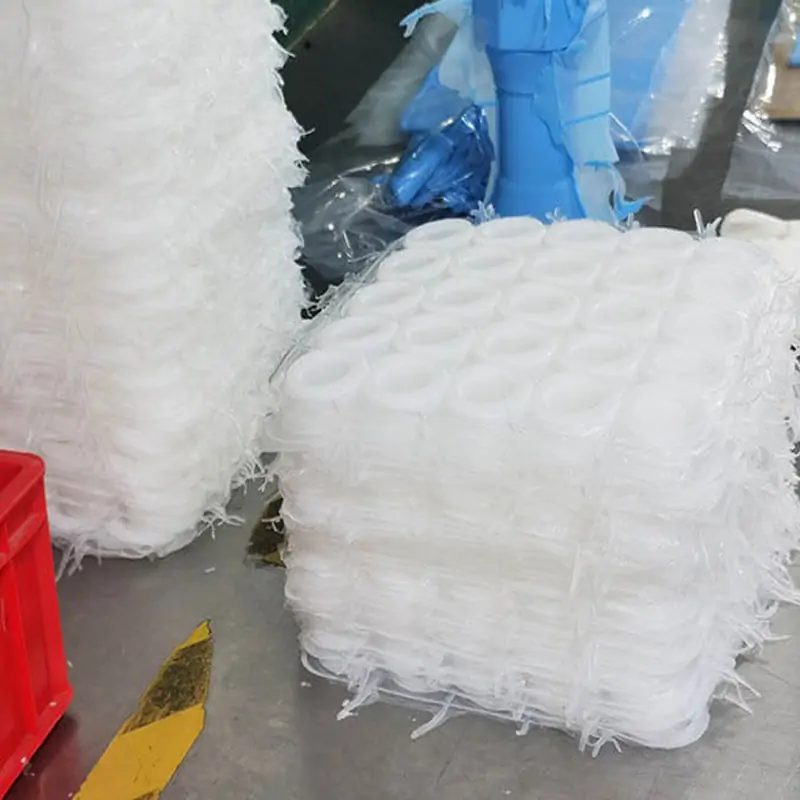
The molded component is positioned in the trimming tool, and the die cuts away the unwanted flash. This approach can provide more consistent results than completely manual trimming when the product geometry is suitable.
Die trimming employs custom sharp steel dies to punch off flash from molded silicone components in one press stroke. This method is typically used when flash holds multiple cavities together in a “mat” and is particularly efficient for parts with consistent geometries.
Advantages:
- Fast cycle speed, uniform edge finish across batches;
- Repeatable dimensional results;
- Good for high-volume production of simple shapes.
Drawbacks:
- Requires custom die tooling cost;
- Poorly suited for 3D curved, deep‑undercut or highly complex silicone parts.
Die trimming may be considered for products with:
- Repetitive shapes
- Defined trimming edges
- Medium to high production volumes
- Consistent dimensions
The feasibility depends heavily on the product geometry and required tolerances.
3. Mechanical Deflashing
For certain silicone and elastomer components, mechanical methods can be used to remove excess material. Depending on the product design, these methods may include tumbling, cutting, grinding, vibratory finishing, mechanical, or other controlled finishing operations.
Silicone tumble trimming loads bulk silicone parts inside rotating or vibratory chambers together with abrasive media. Mutual friction between media and silicone parts rubs away surface flash and minor burrs.
These approaches can process multiple parts in a batch and may improve production efficiency for suitable product geometries. However, the process must be carefully selected because aggressive mechanical treatment may not be suitable for delicate components, thin sections, or products with critical surfaces.
The appropriate method should be selected according to the product rather than automatically applying the same process to every silicone component.
Advantages:
- Fully automated bulk processing;
- Moderate operating cost;
- Handles thousands of pieces per batch.
Drawbacks:
- Risk of surface scuffing or dulled surface finish on soft silicone;
- Cannot thoroughly remove internal flash inside holes or narrow undercut structures;
- Inconsistent results for complex geometries.
Best fit:
High‑volume simple‑shaped silicone parts without ultra‑fine cosmetic requirements.
4. Cryogenic Silicone Deflashing
Cryogenic deflashing is widely considered the gold standard for high-volume silicone flash removal. This automated, computer-controlled batch process removes flash from tens to thousands of molded parts simultaneously.
The process begins by placing batches of molded silicone parts into a perforated drum. Liquid nitrogen cools the parts below the polymer’s glass transition temperature, making the thin flash become hard, brittle, and glass-like. Because the flash is much thinner than the part body, it freezes and embrittles more quickly.
Once embrittled, the parts are tumbled and blasted with a cryogenic-grade polycarbonate media in various diameters to meet part-specific challenges. The brittle flash breaks away cleanly, while the component body remains at a high temperature and is unaffected. After warming to ambient temperature, parts go through screening and quality inspection to separate residual flash debris.
Key temperature considerations:
- Liquid nitrogen boils at -195.8°C and is suitable for all types of rubber, including silicone;
- Dry ice (sublimation point: -78.5°C) is not suitable for silicone rubber, as it cannot achieve the low temperatures required for selective embrittlement;
- Cryogenic deflashing for silicone typically operates at -100°C to -130°C.
Advantages:
- Excellent batch‑to‑batch consistency;
- Reaches hard‑to‑access internal flash locations;
- Nno risk of manual cutting nicks;
- Preserves original silicone surface texture and dimensional tolerances;
- Safe for medical-grade silicones and plastics;
- Calable for large OEM production runs.
Drawbacks:
- Higher equipment and liquid‑nitrogen operational cost compared to tumble or manual trimming.
However, it is not necessary for every custom silicone product. Cryogenic deflashing can be particularly useful for:
- High-volume production
- Small molded components
- Repetitive geometries
- Complex edges
- Parts where consistent flash removal is important
Best fit:
High‑volume precision silicone parts, silicone seals, medical‑grade silicone components, complex silicone fidget toys, silicone consumer goods with strict cosmetic standards, parts with internal holes and hidden undercuts.
Cryogenic deflashing as a batch process that can improve productivity compared with manual trimming for suitable parts.
However, cryogenic deflashing is not automatically the best solution for every silicone product. Product geometry, material, tolerance requirements, and production volume should be evaluated before selecting the process.
The right finishing method depends on:
- Product geometry
- Flash thickness
- Material characteristics
- Production volume
- Required tolerances
- Cost considerations
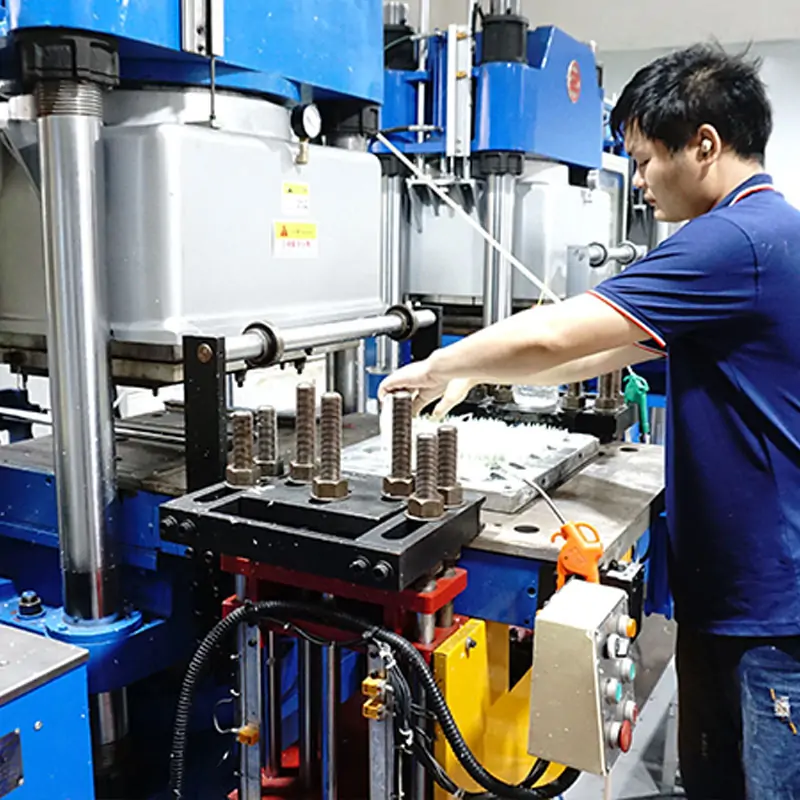
5. Tumble Trimming & Vibratory Finishing
Tumble trimming involves placing parts in a rotating barrel. As the barrel rotates, parts tumble against each other and against abrasive media, wearing away flash. It’s cost-effective for bulk orders but may not work for intricate designs.
For silicone parts, the tumbling process is typically performed with frozen parts. Liquid nitrogen makes the flash more brittle so it breaks off more easily.
Advantages:
- Can process large batches simultaneously
- Lower labor requirements
Disadvantages:
- Less precise than other methods
- Risk of surface damage or part deformation
- Limited to parts that can withstand tumbling
6. Buffing
Buffing uses a rotating abrasive tool to remove flash, typically around the parting line of an undercut.
Advantages:
- Quick method for removing large amounts of flash
- Good for parts with specific flash locations
Disadvantages:
- Labor-intensive
- Inconsistent results
- Risk of surface damage
7. Low-Pressure Sandblasting
Low-pressure sandblasting uses abrasive particles propelled at low pressure to remove flash without damaging the part surface. For thin flash below 0.1mm, parallel spraying at a 15°–30° angle is used. For thicker flash (>0.2mm), cross-spraying paths are applied, with single-pass removal limited to ≤0.05mm to avoid surface damage.
Advantages:
- Effective for thin, delicate flash
- Can reach some complex geometries
Disadvantages:
- Requires careful parameter control
- Risk of surface alteration
8. Water Jetting
Water jetting uses a high-pressure stream of water (sometimes with abrasive particles like silica, aluminum oxide, or garnet added) to remove silicone flash. The water pressure and nozzle diameter are carefully chosen to achieve enough momentum to break the flash while leaving the underlying part undamaged.
Advantages:
- No chemical or thermal damage
- Clean process
- Suitable for delicate electronic components
Disadvantages:
- Specialized equipment required
- Not suitable for all part geometries
Comparison of Silicone Deflashing Methods
| Method | Best For | Volume | Precision | Cost |
|---|---|---|---|---|
| Manual Trimming | Complex parts, prototypes | Low | High | Low tooling, high labor |
| Cryogenic Deflashing | Complex parts, high volume | High | Very high | Moderate |
| Die Trimming | Simple shapes, consistent parts | High | High | High tooling |
| Tumble Trimming | Simple parts, large batches | High | Low | Low |
| Buffing | Large flash removal | Low-Medium | Low | Low |
| Sandblasting | Thin flash, delicate parts | Medium | Medium | Moderate |
| Water Jetting | Electronic components | Low-Medium | High | High |
Selecting the Right Deflashing Method
Choosing the right silicone flash trimming process depends on several factors:
- Production volume: Manual trimming works for prototypes and small batches. Cryogenic and die trimming are better for high-volume production.
- Part geometry: Simple shapes can be die-trimmed or tumbled. Complex parts with blind holes, cross-holes, or intricate features often require cryogenic deflashing.
- Tolerance requirements: If tight tolerances are critical, cryogenic deflashing or precision hand trimming are the best options.
- Material: Silicone’s low tear strength and flexibility make it challenging for mechanical deflashing methods. Cryogenic deflashing is often mandatory for silicone (VMQ).
- Budget: Consider both tooling costs and ongoing labor costs. While cryogenic deflashing may have higher setup costs, it can deliver significant labor savings at scale.
- End‑product application: Baby‑contact silicone items, food‑grade silicone accessories and medical silicone parts demand thorough flash elimination to meet safety compliance standards.

How to Reduce Silicone Flash During Manufacturing?
The best way to manage flash is not simply to remove it afterward. While trimming can address existing flash, mold, and process optimization issues, reducing flash generation at the source can effectively decrease the workload of secondary processing and the overall cost of silicone manufacturing.
Several factors can influence flash formation:
- Mold Design: The mold’s parting line, cavity structure, vents, and closure surfaces need to be properly designed for the product.
- Mold Condition: Wear or contamination at the mold interface can affect how the mold closes and may contribute to unwanted material leakage.
- Material Loading: For compression molding, accurate material weighing and placement can help control excess material. Siliconexy’s compression molding guide notes that excessive material can increase flash, while insufficient material may result in incomplete cavity filling.
- Process Control: Appropriate molding parameters and consistent production conditions help maintain repeatable product quality.
Good flash control begins before the trimming process. A well-designed manufacturing process should also strive to minimize flash generation during the molding stage.
How to Reduce Silicone Flash Before Production?
The best way to manage flash is to consider it during product development.
- Optimize Product Design. Designers should consider: Parting-line location, wall thickness, draft and mold-release requirements, openings and holes, complex geometries, and critical dimensions. Early design for manufacturing (DFM) can reduce potential production problems.
- Optimize Mold Design. Precision tooling and appropriate mold construction can help control material flow and reduce unwanted flash.
- Select the Right Molding Process. The choice between: Silicone compression molding, silicone injection molding, and LSR injection molding. other silicone manufacturing processes should be based on product geometry, production requirements, volume, and quality expectations.
If you use pre-made molds to produce silicone products, you can reduce the flash by adjusting the following aspects.
- Maintain precise mold clamping pressure and well‑aligned mold tooling;
- Optimize injection speed and pressure parameters for LSR injection molding or compression molding;
- Regular mold maintenance to repair worn parting‑line surfaces;
- Reasonable vent design to release trapped air without excessive silicone overflow.
Even with ideal setup, complete zero‑flash silicone molding remains difficult for highly complex custom silicone designs, so flash removal stays a necessary quality checkpoint.
Silicone Flash Removal and Quality Control
Flash removal should not be considered a completely separate operation from quality control.
After trimming, finished parts can be checked for:
- Remaining flash
- Excessive trimming
- Damaged edges
- Surface defects
- Dimensional consistency
- Product appearance
For precision custom silicone products, the final part should be evaluated against the approved drawing, sample, or applicable specifications. For OEM customers, trimming should be considered part of the overall manufacturing plan rather than an isolated finishing operation.
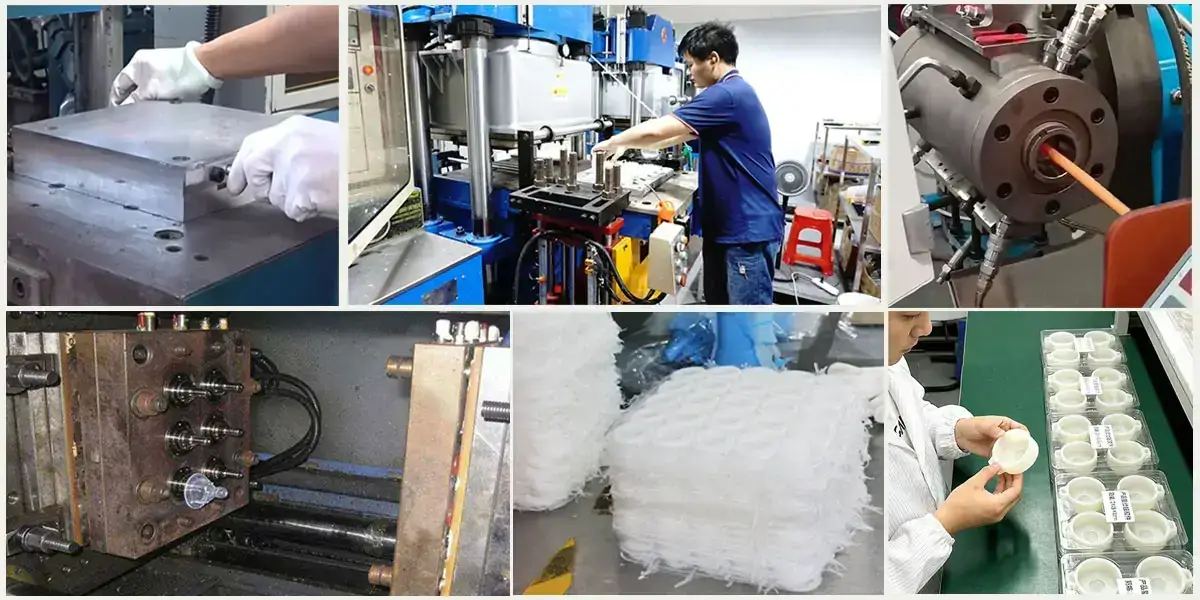
As a professional custom silicone products manufacturer, Siliconexy supports the manufacturing process from:
Product Design → Mold Design → Silicone Molding → Flash Removal & Trimming → Quality Inspection → Packaging
Our team can evaluate the product structure, parting line, production requirements, and finishing expectations before mass production. This approach helps customers develop custom silicone products with consistent appearance and reliable manufacturing quality.
What Should Buyers Ask a Silicone Manufacturer About Trimming?
Before placing an OEM order, buyers can ask the manufacturer:
- Where will the mold parting line be located? This helps determine where potential flash may appear.
- Will the product require manual trimming? Ask whether trimming is included in the quoted manufacturing process.
- How are trimmed products inspected? Ask how the manufacturer checks appearance, dimensions, and critical product features.
- Can the mold design reduce flash? An experienced manufacturer should be able to evaluate whether tooling improvements can reduce post-molding finishing requirements.
Silicone Flash Removal and Quality Control at Siliconexy
For custom silicone products, achieving a good molded part is only part of the manufacturing process.
At Xinyin (Siliconexy), we understand that silicone flash removal is not a one-size-fits-all process. Every part has unique requirements, and we work closely with our clients to select the optimal deflashing method for their specific application.
Siliconexy (Xinyin) integrates post-molding finishing into its production workflow, including: Silicone molding, Flash removal, trimming and finishing, product inspection and packaging
This approach allows each production stage to be considered as part of the final product quality rather than treating trimming as an afterthought.
Whether you need custom silicone gaskets, silicone seals, silicone electronic accessories, silicone kitchen products, silicone baby products, or other OEM silicone products, the required finishing process can be evaluated according to the product’s design and application.
Conclusion
Silicone flash removal and trimming is a decisive post‑molding step that defines final silicone part quality, appearance and functional performance. Manual trimming, die trimming, tumble trimming and cryogenic deflashing each deliver distinct trade‑offs on speed, cost, precision and part compatibility.
Understanding the available options and the factors that influence the right choice ensures you get silicone parts that perform reliably, look professional, and meet quality standards.
At Siliconexy, we match your custom silicone product’s design, batch scale and compliance requirements to suitable silicone deflashing workflows for OEM and ODM silicone manufacturing. We provide OEM and ODM custom silicone product manufacturing support from product development and mold manufacturing to molding, trimming, quality inspection, and packaging.
Have a silicone product that requires professional molding and finishing? Contact us to discuss your project and manufacturing requirements.