If you customize or wholesale custom molded silicone products, you have likely noticed a faint thin seam running across the surface of finished parts. This subtle mark is known as a parting line (also referred to as a mold seam, flash line, or witness line) on silicone products, one of the most common and unavoidable features in silicone molding manufacturing. Many buyers confuse it with product defects, while it is actually a normal molding trace formed during standard silicone production processes.
A parting line is a normal result of the molding process. It marks the area where two or more sections of a mold meet and separate to release the finished silicone part. The location and design of this line are important because they can affect the product’s appearance, flash, sealing performance, demolding, and manufacturing cost.
For companies developing custom silicone products, understanding parting lines early in the design process can help avoid unnecessary mold modifications and cosmetic or functional problems during production.
In this guide from Siliconexy (Xinyin), we will break down the definition, formation causes, common types, influencing factors, and professional solutions to smooth silicone parting lines, helping global clients better judge silicone product quality and optimize OEM/ODM customization projects.
Basic Definition: What Is a Silicone Parting Line?
A parting line (also called a mold separation line, joint line, or PL) is the seam created where the two halves of a mold meet. During molding, silicone fills the cavity under heat and pressure. If even a microscopic gap exists between the mold halves, a small amount of material flows into that gap and cures, leaving a fine raised or recessed line on the finished product.
All molded silicone items, whether produced via LSR liquid silicone injection molding or HCR solid silicone compression molding, require split molds for demolding. The tight assembly gap between mold cavities will leave a faint linear mark or thin excess material edge on finished silicone products, which is the parting line.
It is critical to distinguish that a standard parting line is not a quality defect. It is an inevitable technical feature of silicone mold manufacturing. Only uneven, raised, or offset parting lines that affect appearance and usage can be categorized as molding flaws.
On every molded silicone product, the parting line leaves either a subtle witness mark or visible flash. You cannot eliminate it entirely. The real question is not whether a parting line will exist, but where it will appear and how well it is controlled.
This distinction matters for several reasons:
- Mold precision indicator. The sharper the machining and assembly accuracy of the mold, the finer and less visible the parting line becomes.
- Venting pathway. The parting surface also serves as the primary channel for air to escape during injection. Proper vent design helps silicone fill the mold smoothly and reduces excess flash.
Aesthetic and functional impact. For silicone baby products, medical devices, and silicone consumer electronics, a smoother, lighter parting line is preferred. And in sealing applications, its placement can directly affect performance.
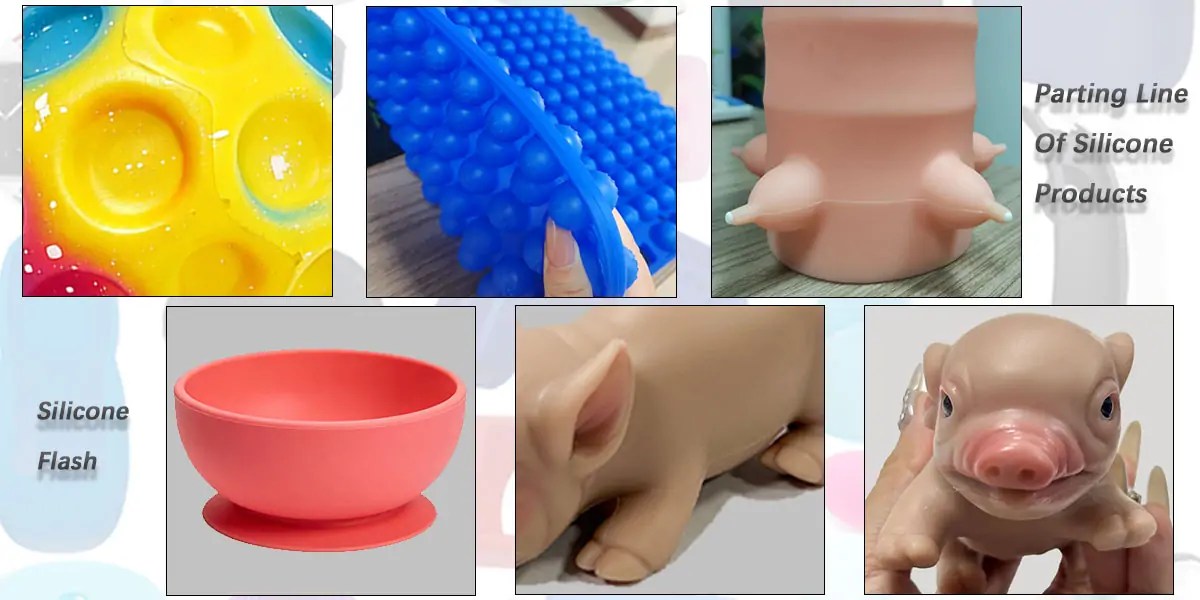
What Does a Silicone Product Parting Line Look Like?
The appearance of a parting line depends on the mold design, product geometry, mold condition, material, and manufacturing process.
Based on appearance, position, and processing difficulty, mainstream silicone product parting line types in the industry are divided into three categories:
- Smooth witness parting line: The standard qualified type. The line is faint, flat, smooth to touch, and does not affect product appearance or performance. It is widely used in food grade silicone products, silicone daily necessities, and medical silicone parts.
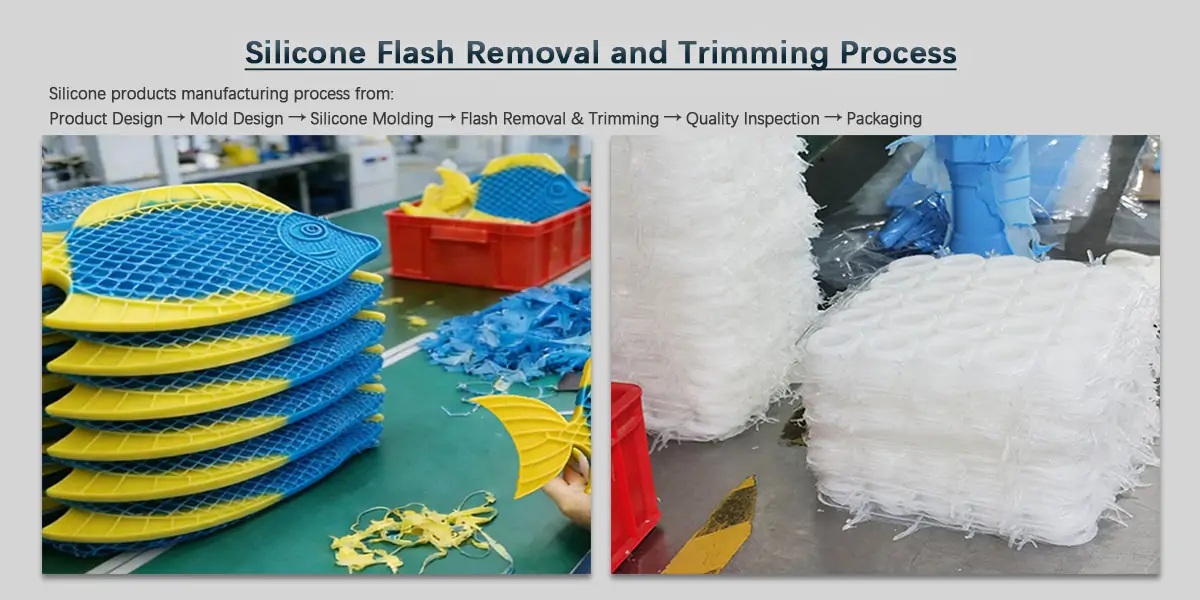
- Flash parting line: With thin excess silicone burrs on the seam. It is a common semi-finished state and can be eliminated via post-processing trimming and grinding.
- Offset/stepped parting line: Caused by inaccurate mold assembly or severe wear. The uneven seam affects product aesthetics and may cause assembly failure, requiring mold repair or replacement.
Silicone Product Parting Line may appear as:
- A fine seam
- A subtle raised line
- A slight surface transition
- A visible witness mark
- A thin edge of excess silicone when flash occurs
A well-designed and properly maintained mold can produce a relatively subtle parting line. However, if silicone enters a small gap between mold surfaces, excess material can form along the parting line. This excess material is known as flash.
Common Types of Parting Lines in Silicone Molding
Depending on mold structure, parting lines may be classified as:
- Straight Parting Line. Two flat mold halves; produces a single linear seam (most common).
- Stepped Parting Line. Mold halves have different depths; seam follows a stepped path.
- Curved Parting Line. Used for spherical or complex parts; mold halves meet along a curved surface.
- Multi-Cavity Parting Line. In molds producing multiple parts at once, each part has its own micro-parting line.
Designing the parting line location is a critical step in Design for Manufacturing (DFM). Experienced mold designers place the parting line on a non-critical or non-visible surface whenever possible.
Parting Line vs. Flash: What Is the Difference?
These two terms are often confused, but they describe different things.
1. Parting Line
The parting line is the boundary where the mold sections meet and separate.
2. Witness Mark
A witness mark is the visible trace left on the molded product where the mold sections met.
3. Flash
Flash is excess silicone that extends beyond the intended product geometry because material has entered a gap between mold surfaces.
4. Deflashing
Deflashing is the secondary process used to remove unwanted excess silicone from the finished part.
Therefore, a parting line does not automatically mean that a silicone product has a defect. A product may have a visible but acceptable parting line with little or no problematic flash. Conversely, excessive flash along a parting line may require trimming or another deflashing process.
Why Do Parting Lines Exist?
Every molded part (regardless of whether it’s silicone, plastic, or rubber) has a parting line because molds must open to release the finished part. The parting line is therefore not a defect in itself, but rather an inherent byproduct of the molding process.
The formation ofsilicone mold parting lines is closely related to mold structure, material characteristics, and production processes. Key factors that influence parting line appearance include:
- Mold split structure design: Silicone molds are composed of at least two movable halves to facilitate product ejection. The splicing interface of mold cavities naturally forms a parting line position, which is fixed during mold development and cannot be completely eliminated.
- Mold machining tolerance: Even precision CNC-machined molds retain a tiny clearance between halves, typically 0.01–0.05 mm.
- Clamping tonnage: Insufficient clamp force allows the mold to “breathe” slightly, increasing flash.
- Low viscosity of silicone material: Especially for liquid silicone rubber (LSR), the ultra-low fluidity allows the material to penetrate into micro mold gaps as small as 0.0002 inches during high-temperature vulcanization, forming thin flash along the parting line.
- Venting and flash-trap design: Proper venting channels redirect excess material away from the cavity edge.
- Production and mold wear factors: Long-term mass production causes slight mold edge wear and assembly tolerance deviation, leading to raised or misaligned silicone parting line flash on finished products.
Why Is Parting Line Design Important for Custom Silicone Products?
For a custom silicone product manufacturer, parting line design is one of the important decisions made during mold development. A poorly positioned parting line can create several problems.
A poorly placed parting line can trigger expensive mold revisions, scrap thousands of parts, and delay a product launch by weeks. A well-designed one, by contrast, produces a near-invisible seam, minimal post-processing, and high yield rates.
The location of the parting line determines three things simultaneously: the direction of mold opening (and therefore the draft direction required for clean ejection), where any surface vestiges will appear, and the cost and type of secondary finishing operations needed.
How Parting Lines Affect Silicone Product Quality?
While a parting line is rarely a functional failure, it can affect several aspects of the finished product:
- Aesthetics. Visible parting lines may be unacceptable for consumer-facing or transparent products.
- Sealing performance. In gaskets or medical components, an uneven parting line can create micro-leakage paths.
- Tactile feel. A rough parting line can be felt by hand, lowering perceived quality.
- Optical clarity. In clear or translucent silicone, parting lines scatter light and look unsightly.
Additionally, unreasonable parting line placement may interfere with product assembly and reduce production yield in mass manufacturing.
For food-grade silicone, medical-grade silicone, and baby products, most manufacturers adhere to FDA and LFGB standards, which require that any surface imperfection does not compromise safety or cleanliness.
Professional Ways to Optimize or Conceal Silicone Parting Lines
As a professional custom silicone product manufacturer, Siliconexy (Xinyin) adopts standardized mold design and post-processing technologies to control parting line quality, minimizing visible traces for client products. Here are the core industry optimization solutions:
- Optimize mold parting line placement: In the mold design stage, arrange the parting line on product edges, hidden corners, or non-appearance surfaces to avoid affecting the main visual area.
- Optimize mold surface finish: Polishing mating surfaces to an SPI-A1 or A2 mirror finish minimizes seam visibility.
- Use proper venting: Allows trapped air and excess material to escape without forcing flash into the cavity.
- Review the Product Geometry: Sharp transitions, thin edges, sealing areas, and complex features should be considered during DFM.
- Increase clamp tonnage: Prevents mold “breathing” during injection.
- Precision mold processing & maintenance: Adopt high-precision CNC machining to control mold assembly tolerance, and conduct regular mold polishing and wear maintenance to avoid offset seams.
- Strict post-processing treatment: Remove parting line flash via manual trimming, mechanical grinding, and surface polishing to achieve a seamless smooth finish, suitable for high-standard OEM silicone orders.
- Reasonable molding parameter adjustment: Optimize injection pressure, vulcanization temperature, and mold clamping force to reduce silicone overflow and inhibit excess flash formation.
These decisions can help reduce unnecessary trimming, rework, and mold modifications during mass production. For custom silicone products, partnering with a manufacturer experienced in mold flow analysis can predict and mitigate parting line issues before tooling is cut.

Parting Lines in Different Silicone Manufacturing Processes
Parting-line considerations can vary depending on the silicone product manufacturing process.
Compression Molding.
In silicone compression molding, silicone material is placed into a mold cavity and compressed as the mold closes. The parting surface needs to contain the material while allowing the finished product to be removed after curing.
Excess material can form flash around the mold’s parting surface, so material quantity, mold design, and compression conditions are important.
LSR Injection Molding.
Liquid Silicone Rubber (LSR) injection molding uses liquid silicone that flows into the mold cavity before curing.
Because LSR has relatively low viscosity before curing, accurate mold fitting and effective parting-line control are particularly important for minimizing flash.
Silicone Overmolding.
For silicone overmolding, the parting line needs to be considered together with the substrate, insert, sealing areas, and demolding requirements.
This is especially important when silicone is molded around plastic, metal, or electronic components.
Does the Parting Line Affect Silicone Product Cost?
Yes, parting lines do affect the cost of silicone products. The complexity of a parting line can influence mold construction, tooling complexity, finishing requirements, and production processes.
For example, a product geometry that allows a relatively simple mold separation may be easier to manufacture than a design requiring complicated slides, inserts, or other tooling mechanisms.
A difficult parting line may also increase secondary processing if additional trimming or deflashing is required. For this reason, silicone mold design should be reviewed during the product development stage, before the tooling is finalized.
How Should OEM Buyers Discuss Parting Lines With a Silicone Manufacturer?
If you are developing a custom silicone product, don’t wait until the first production sample to discuss the parting line. When sourcing custom silicone parts, the parting line should be addressed explicitly in the technical documentation rather than left to the supplier’s default practice.
Consider including:
- Parting line location. Mark the intended position directly on the 3D model or drawing, identifying which surfaces are cosmetic and which are functional.
- Acceptable flash tolerance. Specify a maximum flash thickness (e.g., ≤0.05 mm for cosmetic parts, ≤0.1 mm for non-visible surfaces).
- Surface finish expectations. Clarify whether the parting line should be left as-molded, trimmed, cryogenically deflashed, or polished.
- Critical-to-quality zones. Flag sealing surfaces, snap-fit interfaces, and grip areas where parting line ridges are unacceptable.
Industry practice treats features inherent to molding (including parting lines, gate marks, slight flash, and shrinkage) as normal process outcomes, not defects, unless they exceed agreed tolerances. The supplier’s manufacturing standards document should define these tolerances precisely.
During the DFM stage, provide:
- 2D product drawings & 3D CAD files
- Critical dimensions
- Cosmetic surface requirements
- Sealing requirements
- Material requirements
- Expected production volume
- Applicable tolerance requirements
Then ask the manufacturer to review:
- Proposed parting-line location
- Mold-opening direction
- Demolding feasibility
- Potential flash areas
- Critical sealing surfaces
- Cosmetic surfaces
- Required trimming or deflashing
- Mold complexity
A professional silicone product manufacturer should be able to identify potential parting-line issues before mold manufacturing begins.

Conclusion
A parting line may look like a small detail on a finished silicone product, but it is closely connected to silicone mold design, product appearance, flash control, demolding, sealing, and manufacturing efficiency.
A parting line on a silicone product is more than just a cosmetic detail. It’s a window into the quality of the mold, the precision of the process, and the expertise of the manufacturer. By understanding what causes parting lines and how to minimize them, buyers and engineers can make more informed sourcing decisions.
The goal is not necessarily to eliminate the parting line. Instead, good product and mold design should determine: where the parting line is located, how visible it is, how much flash is acceptable, and whether it affects the product’s function.
For OEM/ODM projects, discussing the parting line during the DFM stage can help prevent avoidable tooling and production problems.
At Siliconexy (Xinyin), custom silicone product development can involve multiple manufacturing technologies, including compression molding, LSR injection molding, extrusion molding, and silicone fabric coating and curing. For a new silicone product, reviewing product geometry and mold requirements before tooling is an important part of preparing the design for mass production.
Have a custom silicone product in development?
Share your product drawings and requirements with Siliconexy to discuss material selection, mold design, and the appropriate silicone manufacturing process.
At Siliconexy, we strictly control every link from mold design, precision molding to post-processing polishing, providing high-quality, low-defect OEM/ODM silicone products for worldwide clients.
Frequently Asked Questions
Q1: Is a parting line on silicone products a defective product?
- A: No. A faint, flat parting line is a normal molding feature of all molded silicone products, not a quality defect. Only uneven, sharp, or severely offset parting lines that affect use and appearance are unqualified flaws.
Q2: Can silicone parting lines be completely removed?
- A: It is impossible to completely eliminate parting lines due to the split mold structure. But through precision mold making and professional post-processing, parting lines can be made almost invisible to the naked eye and undetectable by touch, meeting high-end product standards.
Q3: What is the difference between a parting line and silicone flash?
- A: The parting line is the boundary where mold sections meet. Flash is excess silicone that extends beyond the intended product geometry, often along the parting surface.
Q4: What products require strict parting line control?
- A: Food grade silicone utensils, medical silicone parts, beauty silicone tools, and high-end consumer electronic silicone accessories require ultra-smooth parting lines to meet hygiene, safety, and aesthetic requirements.
Q5: Where is the best place for a silicone mold parting line?
- A: There is no universal location. It is generally preferable to place it on a less visible or non-functional area when product geometry permits, while also ensuring proper mold opening and demolding.
Q6: Does every silicone molded product have a parting line?
- A: Most products made using a mold with separating sections will have some form of parting boundary. Its visibility and shape depend on the mold construction and product design.